The Five “Books” of the Psalter
Bible scholars note that the Psalter is a bit like a hymnal, with songs of one type or message right next to songs with a very different type or message. Nonetheless, they have discovered a structure or outline to the Book of the Psalms.
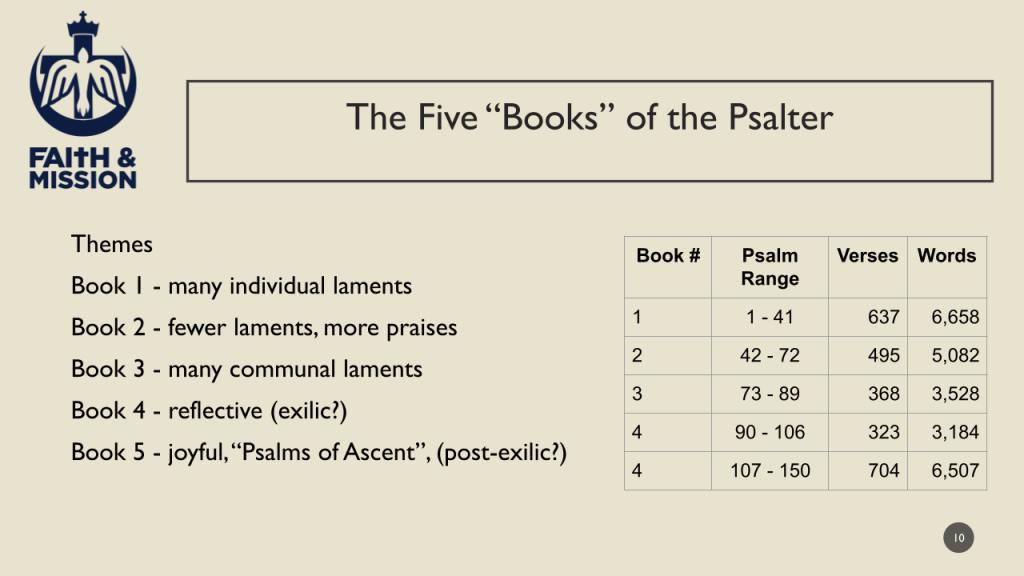
The first thing to note is that the Psalter can be divided into five groupings, or Books. Most printed Psalters will mark the beginning of the next Book, and you will most likely see headings in the Bible you use. As you will see, the Psalter seems to record the arc of the kingdom: the struggles David faced gaining control, the joy once it looks like he’s winning, the sadness of the divided kingdoms and then foreign overlords, the time exiled away from Zion, and then a joyful return and rebuilding of the Temple.
Book 1
is an Introduction and then it contains many of the individual laments of David. It is Psalm 1 – 41. We’ve already talked about the two psalms that introduce the major literary genres: wisdom literature and messianic prophecy. Then we have many laments by King David, though not every psalm in Book 1 is a lament. In these, David expresses a wide range of emotions, and his fortunes vis-a-vis the Lord and his enemies rise and fall. In the final psalm of the book, David is abandoned by his friends and surrounded by enemies as he lies ill because of his sins. For the most part, Book 1 presents the sufferings and trials of David at the hands of his enemies, confident of salvation but still being persecuted and not yet delivered by the hand of God.
Book 2
seems to cover the rise of the Davidic Kingdom. It is here in Book 2 that we find some psalms written by the Sons of Korah (42-49), and a Psalm of Asaph (50). The rest are considered psalms of David. For the first time, we find Mount Zion psalms exalting the greatness of the city of David and its sanctuary. In this book, we have two exuberant royal psalms (45, 72) that match the spirit of Psalm 2 which introduced the messianic theme. The end of Book 2 might be understood as David at the end of his life. The last psalm (72) reads like a father’s prayer for his son, and it is the psalm of Solomon – which probably means about Solomon rather than written by Solomon. The psalm is a list of blessings the psalmist wishes for the king.
Book 3
covers the fall of the Davidic Kingdom, with some psalms of Asaph (73-83) and some from the sons of Korah (84-89). The last two in this book are particularly despondent, a bit like a dark night of the spirit experience that the mystical fathers like St. John of the Cross describe.
Book 4
opens with the psalm of Moses, which is a plaintive cry of “how much more, Lord?” that fits with being in exile to Babylon. That is followed by a long list of psalms of praise acknowledging God as sovereign over all the earth, from its heavens to the creatures of the sea and everything in between. The last two psalms in this book contrast the faithfulness of God to his people with his people’s unfaithfulness to God through history.
Book 5
has themes of rejoice and restoration of the Temple. There is a cycle of lament to praise in psalms 108-18, with Davidic psalms of petition (108-9) leading to praise of the Davidic king (110) and then to thanksgiving psalms (111-118). The second cycle in Book 5 is another movement from lament to praise. The psalms of ascent to the Temple (120-134) is followed by hymns of praise (135-36). And the final cycle of lament to praise finishes the Psalter. From a lament over exile (137 – this is the basis for a famous Bob Marley song) and a collection of Davidic laments (138-44), there is a shift to Davidic praise of God’s kingdom (145) and then the concluding hymns of praise (146-50).
Book 1: Laments and How to Handle Life
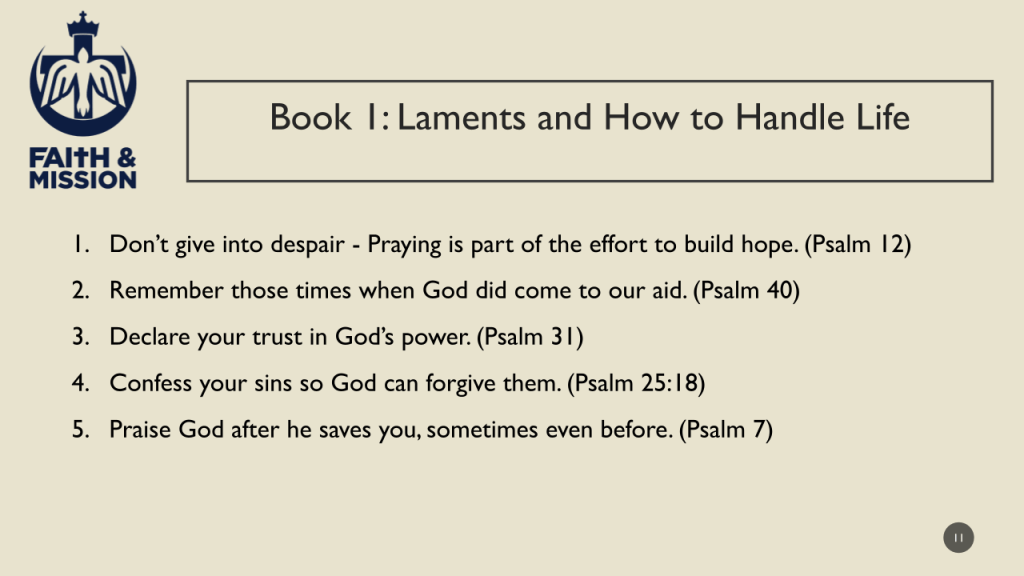
Let’s take a look at how the laments in book 1 of the Psalter are more than just crying about tough times. David, who we acknowledge is the author of most of the Psalms, gives us examples of how to handle hardships in our own life in at least five ways.
The first way is not to give into despair or to give up on God. Take a look at Psalm 12 which is kind of dark. It starts out by saying in verse one, “help, Lord; for there is no longer any that is godly; for the faithful have vanished from among the sons of men. The second verse piles on: everyone utters lies to his neighbor; with flattering lips and the double heart they speak.” It wishes that those who are boasting an flattering and believe in the power of their narrative will be punished. But it turns to the Lord as a place for safety, as it says that the promises of the Lord are promises that are pure. And then the psalmist turns to God: do thou, O Lord, protect us, guard us ever from this generation. On every side the wicked prowl, as vileness is exalted among the sons of men.”
So the message of the Psalm is even though the world is awful in so many ways, God is still in control. It is okay to pray to God and have that prayer be mostly a litany of the terrible things about the world today. The message of this psalm is that even in listing those terrible sins to God and wishing that there be some justice even when it doesn’t seem that there is any justice right now, all of that is a prayer to God. The fact that we whine and bemoan our troubles to God is indirectly an acknowledgment that God has the power to fix the bad things that we see. So in our complaining, we are acknowledging God as the God of ultimate justice. So just the act of praying is part of how we build and sustain the virtue of hope: the confidence that there is an end to the world that ends in pure and godly justice and that those of us who try to follow God will experience that beauty of salvation even if our time on this earth is filled with troubles.
The second message that we can find in these laments in the second tool that we can use in our prayer like that is suggested by book one is that we should remind ourselves of the times in our own lives and of course also in the history of salvation when God came and rescued us. In Psalm 40, verse two says: “he drew me up from the desolate pit, out of the miry bog, and set my feet upon a rock, making my steps secure.” The next verse continues that song of confident memory: “he put a new song in my mouth, a song of praise to our God. Many will see and fear, and put their trust in the Lord.” In this Psalm we also see a theme that recurs many times in the Psalter, and that is the theme of the idea that the sacrifice God really wants is not the blood of animals but relationship with us based on praise and thanksgiving. Verse six says, “sacrifice and offering thou does not desire; but thou hast given me an open ear. Burnt offering and sin offering thou hast not required.” In verse eight offers the contrasting and more effective and better response: “I delight to do thy will, O my God; thy will is within my heart.”
You can see that God really wants a relationship with us that is all encompassing, and we already see this in the first book of the Psalms. It is perfectly fine with God to list all the troubles in our lives, because that listing itself is part of our relationship with him. It is also important that we have a complete memory, which will necessarily include those times when God helped us. And so along with our laments we should include those memories of the times when God saves us.
The third theme that we see in book 1 is to affirm our confidence that God can save us that he has the power to save us. These are acts of faith, and we see that clearly in Psalm 31. This is one of the Psalms that Jesus prayed from the cross. After pointing out how lonely he is because all of the people who should be his friends have walked away and all of its adversaries seem to have won the day, David sings — and Jesus sings from the cross — the following verses: “but I trust in you, O Lord, I say,’ you are my God.’ My times are in your hand; deliver me from the hand of my enemies and persecutors!”
Even in the worst times of our lives, we can and we should declare our trust in God’s power. Jesus shows us that on Good Friday, which is both the pinnacle of his earthly ministry and also the very worst day of his earthly ministry. So in some ways our worst days can also be our best days, if we can see the hand of God in them.
The fourth theme that we see in book 1 is the willingness to confess our sins to God. In Psalm 25, we see that a relationship of trust in God is based on learning God’s ways, counting on his mercy, and then admitting those places and times where we have not followed his ways. It opens with: “to you oh Lord I lift up my soul. Oh my God, in you I trust, let me not be put to shame” and then it continues in verse four with, “make me to know your ways oh Lord; teach me your paths. Lead me in your truth, and teach me, for you are the God of my salvation; for you I wait all the day long. Be mindful of your mercy oh Lord and of your steadfast love. Remember not the sins of my youth, or my transgressions;” in verse 11, we hear: “for your namesake or Lord, pardon my guilt, for it is great.” And it closes with a statement of commitment and trust: “oh guard my life and deliver me; let me not be put to shame, for I take refuge in you.”
The fifth theme we see in the first book of the Psalms is the importance of praising God. That phrase is appropriate obviously after he has rescued you, but Psalm seven shows us that it is also appropriate to say it before you need rescuing. The Psalm opens with: “O Lord my God, in you do I take refuge; save me from all my pursuers, and deliver me, lest like a lion they rend me, dragging me away, with none to rescue.” And the Psalm closes with, “I will give to the Lord the thanks due to his righteousness, and I will sing praise to the name of the Lord, the most high.” We see that praise to God is fitting as a sign of confidence and faith.
So we see wisdom themes in book 1, but we also see the messianic themes. Many of the Psalms in book 1 paints David as the suffering and persecuted King. These verses foreshadow the sufferings and persecutions of Jesus, who is son of David. Jesus refers to Psalm 41, which is right at the end of book 1, when he is describing the betrayal of Judas and notes that even my bosom friend in whom I trusted, who ate of my bread, has lifted his heel against me. (v. 9). On the cross he cries out the first line of Psalm 22, which is my God my God why have you forsaken me? And he quotes from Psalm 31 at the very end when he says into your hands I commend my spirit. The Beatitudes that begin the sermon on the Mount contain phrases that we see in book 1. In Psalm 37, David says the meek shall possess the land, which corresponds to one of the Beatitudes: Blessed are the meek, for they shall inherit the earth. In Psalm 30, David says, “you have turned my mourning into dancing.” Jesus says, “Blessed are those who mourn, for they shall be comforted.”
Book II: Triumphs of David

After many psalms that the persecuted servant of God struggling and asking for rescue, the second set of psalms that makes up Book II is more optimistic, and it has many more psalms of praise.
Authors other than David are included in Book II, principally the choir of singers appointed by King David to compose and sing psalms.
The last psalm of Book II is a long psalm of praise and blessings for the king. It asks for the king to be blessed with justice as a ruler, but he also should receive plenty of earthly prosperity. It asks that his life and rule be long, that his kingdom extend from sea to sea, receiving tribute from other nations. This is the Psalm which is introduced as a Psalm of Solomon, and the text certainly seems to be describing the reign of Solomon. We know that Solomon ultimately turned away from the Lord, but early on he was blessed with wisdom and riches just as the Psalm requests. Taken spiritually, this Psalm also foretells the kingdom of Heaven ruled by Jesus.
On that happy note, Book II ends.

 Bound in Love
Leave a comment