There are many ways that we can read the Psalms. One of the great church fathers from the fourth century, St. Athanasius, wrote a letter to his spiritual directee with advice on how to read the Psalms. The state argued that the Psalter was basically a synopsis of the whole Bible. He said that everything in the Bible could be found in some form in the book of Psalms. He added that it is possible for us, “to find in the Psalter not only the reflection of our own souls state, together with precept and example for all possible conditions, but also a fit form of words wherewith to please the Lord on each of life’s occasions.”

He then gave a list of different emotions or situations in life and suggested Psalms to fit those occasions. I have presented a couple of them here for your enjoyment. The point is that God understands that we are not always in the quote-unquote “perfect” frame of mind for prayer. He’s okay with that. He really just wants us to share our lives with him. So if we’re filled with indignation about some injustice and kind of want God to visit some vengeance on those guys, God understands where we’re coming from. And in this case he has given us a challenging Psalm 82 where the psalmist wants the guy not only to die but his kids to know what a jerk their dad was and so on and so forth. God may not answer such a prayer exactly the way we phrased it, but he is perfectly fine hearing such a prayer. That is why these uncomfortable Psalms — the ones that were known as the curses — are just as important as the Psalms of praise that wrap up the Psalter.
There are other ways to read the Psalms in addition to letting your mood be your Psalm choosing algorithm. One very good way is to pray the Liturgy of the Hours, which is also known as the Divine Office, or the Breviary. This is the official prayer book of the church. Every deacon and priest has promised to his bishop that he will pray the Breviary every day. The same sort of promises are made by most monks and religious sisters. If you choose to take this on, then you will be praying with the entire Church as you do Morning or Evening Prayer. The current Liturgy of the Hours spreads the 150 Psalms — minus two or three that were omitted for some reason — over a four-week cycle. The older Breviary spreads the Psalms over a one-week cycle. And of course you’ve not made any promises to a bishop, so you are free to take on whatever challenge you want, but it’s okay if you really can’t maintain the schedule you first set up. The Psalms are not about performance, they are about prayer.
If you are a daily mass attendee, then you will get a daily opportunity to pray the Psalms with the responsorial psalm that we hear at every mass.
And professor John Bergsma suggests two ways to enjoy a daily helping of the Psalms. One way — and the simplest way — is to just make a goal of reading five Psalms each day for a month. At the end of a month you will have read the whole book of the Psalms. This is a great way to get familiar with the Psalter. You will see certain phrases repeated. Some of the Psalms are clearly a call and response format, so in the Psalm you will say the same phrase many many times as sort of an answer to the first half of the verse. Look at Psalm 135 for this.
And I would add that you do not need to read the Psalms like you’re a Bible scholar. If the Psalter is really a book of prayer, then you’re going to respond to it in your particular way. It is somewhat interesting to know that this Psalm was probably written after the exile while another Psalm was written well before the exile, but the dating of the Psalms isn’t really critical to your prayer life and your relationship with God. So don’t fret when you run into a phrase or statement that is odd. When you run into one of the challenging verses, like the one that says “blessed are they who dash your little kids against the rock,” don’t rush to try to figure out how to rationalize that statement. Just let God wash over you. Even a challenging verse like that has something to say to us here in the 21st century.
The second way that the professor suggests we read the whole Psalter is to read every 30th Psalm, five at a time, and so in a similar way end up having read the entire book in a month. I think for me that would be so math-heavy that I would have some kind of performance anxiety, but I understand how it might really appeal to somebody who wanted a systematic way to bounce through the book of the Psalms and be sure that he had read all of them.
So try one or two or three of these approaches and get so that the Psalter is something that you have some familiarity with. Once you know the Psalms better, you will realize that fragments of the Psalms show up in the prayers of the mass. If you know Psalm 42, and you attend a Traditional Latin Mass, you will hear that Psalm as the heart of one of the prayers the priest prays at the foot of the altar. Snippets of the Psalms also show up in the Mass that we pray at St. Catherine’s. So your familiarity with the Psalter might make your experience of the Mass even more rich.
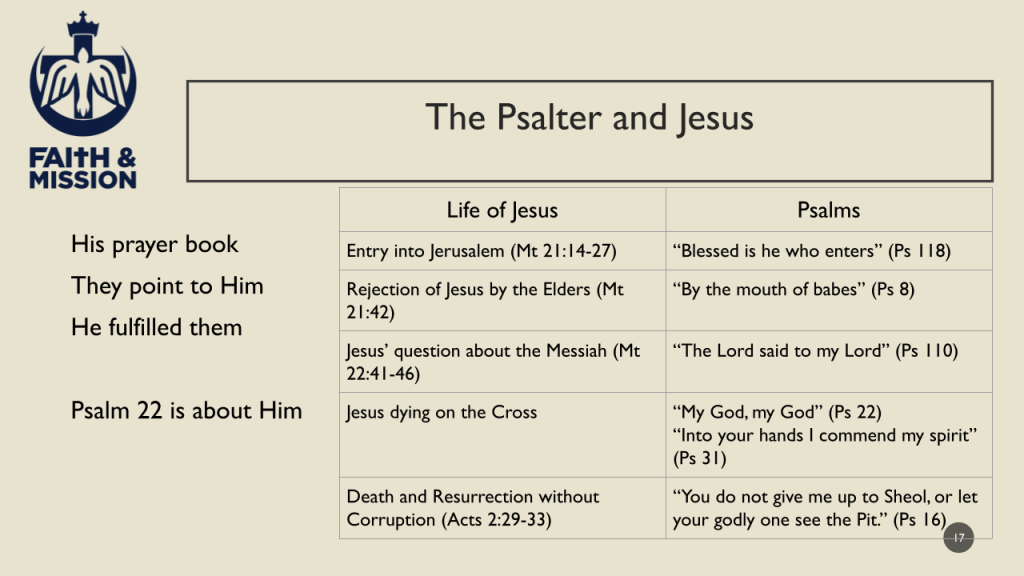
Finally, look at the close connection between Jesus and the Psalter.

 Bound in Love
Leave a comment