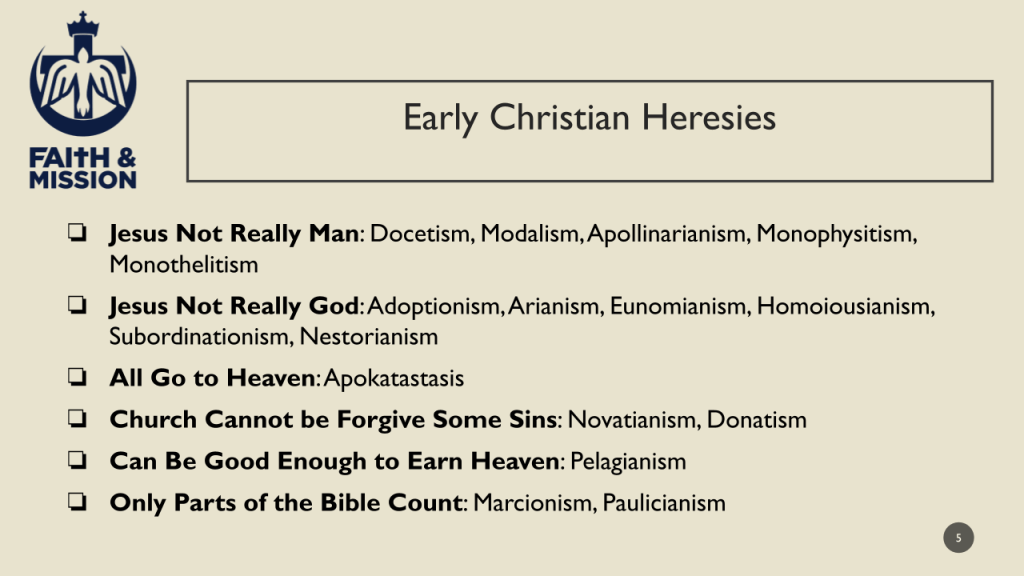
Jesus Not Really Man
Docetism: The humanity of Jesus is an illusion. He only “seems” like a human but is actually God (divine).
Modalism: The three persons of the Trinity are not separate and distinct divine persons but simply three modes or manifestations of one and the same divine being.
Apollinarianism: Jesus had a human body but not a human mind or soul. (These were divine.)
Monophysitism: Jesus only had one nature because his divine nature completely absorbed his human nature.
Monothelitism: Jesus had only one will – similar problem to the one denying two natures.
Jesus Not Really God
Adoptionism: Jesus was not the Son of God from all eternity but was supernaturally adopted by the Father.
Arianism: Denied that Jesus is of one essence, nature, or substance with the Father. He is not equal in dignity, nor co-eternal, nor truly God – merely an excellent being. Catchphrase: “there was a time when he was not.”
Eunomianism: Similar to Aria, Eunomius taught that the Son was unlike the Father in substance and all else.
Homoiousianism: Also known as “semi-Arianism,” it maintains that the Son of God is similar in substance but not equal in substance to the Father. (An iota’s worth of difference.)
Subordinationism: The Son of God is somehow subordinate to the Father in nature, operation, or both. It implies a hierarchical Trinity. Gets one started down the road to Arianism.
Nestorianism: Maintains two distinct persons in Jesus Christ (rather than one person with two natures), so Mary did not bear God but only the Anointed One. (theotokos vs. christotokos)
All Go to Heaven
Apokatastasis: All free creatures will share in the grace of eternal salvation, even in a special way, the devils and condemned souls in hell.
Church Cannot be Forgive Some Sins
Novatianism, Donatism: Denies the power of the Church to forgive sins in certain circumstances (related to the lapsi, those who denounced the Faith under persecution in the middle of the 3rd century). Donatus in the 4th century said complete moral integrity was necessary for priestly ministry and valid sacraments (the opposing phrase was “the work does not depend on the worker”).
Can Be Good Enough to Earn Heaven
Pelagianism: Denies original sin and the necessity of divine grace for salvation. St. Augustine opposed this, saying even the urge to be good was a grace given by God (prevenient grace), and it is impossible for us to work our way into Heaven.
Only Parts of the Bible Count
Marcionism, Paulicianism: Marcion was 2nd century denier of the Old Testament as part of the gospel of the Church because the God described in that was much less nice and loving than the God of the New Testament. 7th century Paul limited the Scriptures to the four Gospels, fourteen letters of Paul, three of John, James, Jude and one to the Laodiceans. Refused to venerate Mary or the Cross (it was a pagan symbol). Very dualistic (matter bad, sacraments don’t matter, spirit good).
Medieval Heresies
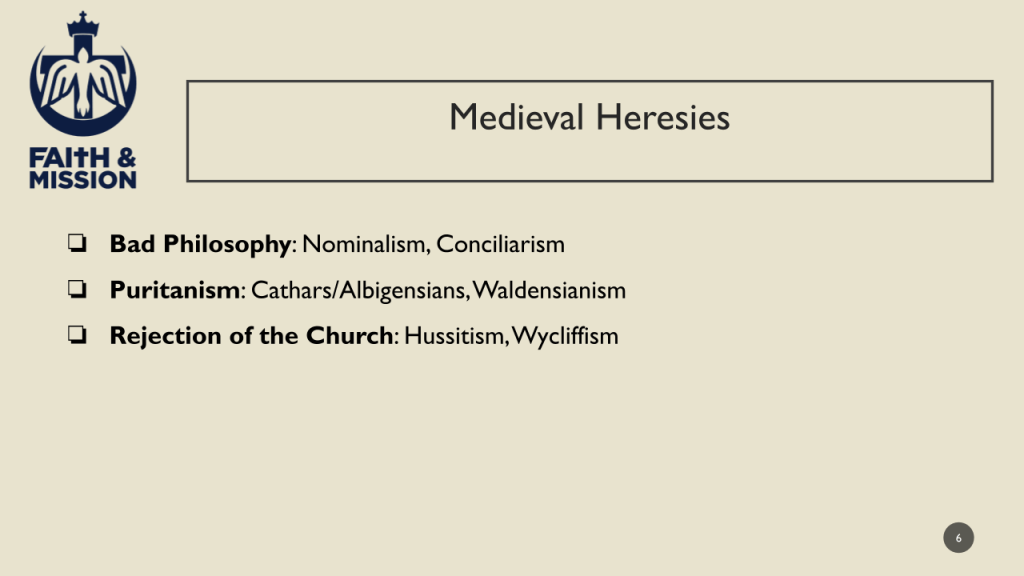
Bad Philosophy
Nominalism: denies the existence of abstract or universal concepts; only sensible particulars in space and time are real or describable, and concepts exist only as “names” (labels) for collections of things.
Conciliarism: the theory that a general or ecumenical council is greater in authority than the Pope. Came from William of Ockham (also the father of Nominalism) in the 1300s, and declared but not approved by a Pope at the Council of Constance in 1418.
Puritanism
Cathars/Albigensians, Waldensianism: Puritans, basically. Peter Waldo preached apostolic poverty as the way to perfection; rejected purgatory, prayer for the dead, ecclesiastical authority.
Rejection of the Church
Hussitism, Wycliffism: Jan Hus in Bohemia (western Czechoslovakia, north of Austria; Prague is the capital) followed the example of John Wycliff in England. Reject the government of the Church, papal supremacy, the sacramental system, and independence of Church property from State control. In England, also called “Lollards”.

 Bound in Love
Leave a comment