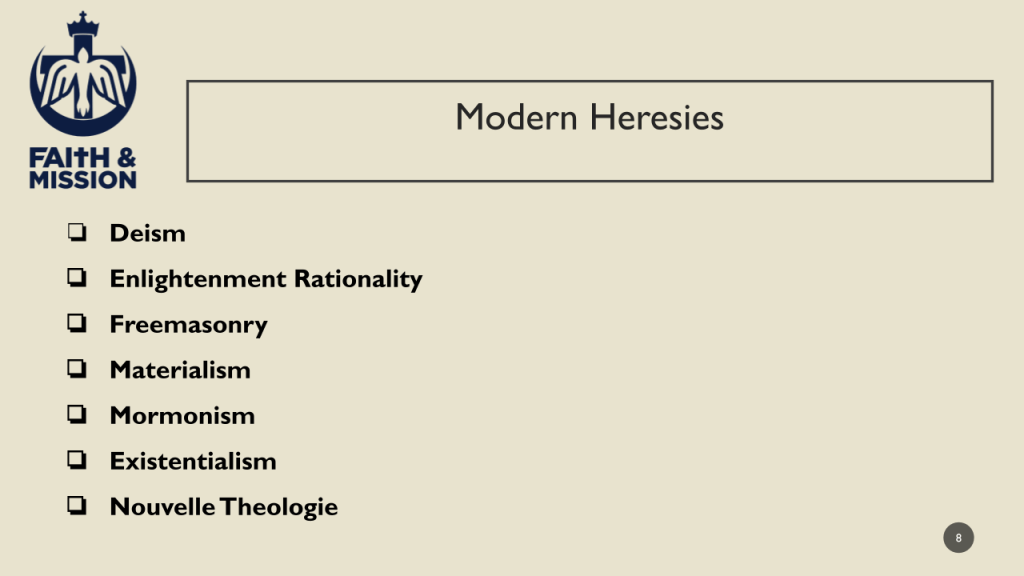
Deism
God is an impersonal force of origin, and he does not intervene in history. Rejects revelation as a source of divine knowledge. Contemporary religions are corruptions of a single pure, natural, simple, and rational religion. (Very connected to Freemasonry; many American Founders were Deists.)
Enlightenment Rationality
A human-centered philosophy and moral system in which religion does not consider divinely revealed dogmas or morals but can be useful for human thriving in certain historical periods.
Freemasonry
A universalist natural religion: a mixture of pantheism, gnosis, and self-salvation based on the fraternity of the bonds of blood and nature. Hierarchy means greater illumination and power, ultimately becoming a god. A complete anti-Church. Cannot be a Catholic and a Freemason.
Materialism
Maintains that empirically observable matter is all that exists; rejects the purely spiritual, so the mind and consciousness are just by-products of a chemical material process.
Mormonism
Rejects the Trinity, original sin, Christian baptism, but polygamy is good.
Existentialism
Original ideas come from Soren Kierkegaard, but the term comes from Jean-Paul Sartre; teaches that “existence precedes essence” which is a flip of the traditional philosophical premise that existence and action follow from essence/being. Human beings create their own values because there is no meaning in the world, and the world is ultimately revealed to be absurd.
Nouvelle Theologie
Developed in the early 20th century and promoted by Henri de Lubac and Yves Congar (important figures in the Liturgical Movement and Second Vatican Council), it taught that theology must move with the times to remain alive. (Think of the Living Constitution as a similar approach to U.S. Supreme Court decisions.)

 Bound in Love
Leave a comment