What’s Coming and Why
Advent is for Christians the beginning of a new year, and for us here in Georgia and everywhere in the northern hemisphere, Advent arrives as the days are getting shorter and shorter down to the point that when we’re right at the end of Advent, we have the shortest day of the year and the longest night of the year and the darkness presses upon us just before the light of the world enters into the world at Christmas.
Advent is certainly about the approaching celebration of the day when Jesus Christ was born in the manger at Bethlehem. But there are two comings that Advent points us to. In addition to the coming of Jesus in the manger as a baby, Advent reminds us that he will come in judgment at the end of time.
Now most of us don’t really spend much time thinking about the end of time. We tend to make plans for tomorrow and for next week and maybe even next month, but God wants us to keep a focus every single day on the last day. And the Sunday readings from the first couple of weeks of Advent are designed to remind us that there will be a last day. Each of us, of course, will have our own particular last day. And on that last day, our destination will be set.
And there are really only two destinations: one destination is the bosom of Abraham, where we enjoy a relationship with our God that is beyond our human comprehension. All of the tensions that have been a part of our relationship with God while we were alive on Earth will be gone, and we will be with him and he will be with us and we will experience pure bliss. That is the hope of Heaven.
The other destination is the opposite of all of that. We will be completely and permanently apart from our creator, and we will be without him and we will not experience bliss, but we will experience the opposite. Perhaps here in Georgia in December during the season of Advent, God gives us short days and long nights, he gives us trees with no leaves that look stark against the sky, he gives us cold days and rainy days and blustery days. Perhaps he gives us all those things so that we can come to understand that there are two choices, and that we greatly prefer one over the other. Having seen December in Georgia, maybe we admit we greatly prefer May in Georgia, when the sun is warm and the days are longer and the breeze is pleasant and the trees have leaves and the flowers bloom.
Advent is a gift to us from God and the church to remind us that yesterday and next week and next month really should not be our focus. Our focus as Christians should be today, the day that the Lord has given us, and it should be the last day. As Christians, we need to remind ourselves that tomorrow is not promised to us. Today is all that we really have. And our Christian walk is to make sure that the day that we were given is lived to the glory of God. All of us have December days and May days, so we know that some days living to God’s glory is harder than it is other days. Some days, the devil seems to take a back seat, and we seem to overflow with charity and kindness and generosity and patience and fortitude. Other days, it takes all our energy not to give up or even lash out because we are frustrated or in some other way tempted by the devil.
Advent is filled with the two hopes that are connected to the two comings of Christ. We have the hope of salvation and justice when Christ comes in all his glory at the end of time. On that day, he will come to close his creation and he will gather into his arms all those who welcomed his embrace. On that day, he will respect the choice of those who rejected his embrace, and he will set them eternally apart from his presence. On that day, all of us will be reunited with our bodies. In some glorified way we will be restored as his creation and yet a new creation. And this will happen for those who said yes to God as well as to those who said no to God. And those of us who are trying to say yes to God have the hope that he will call us his sons and daughters on that last day.
We also have the hope of mercy when Christ comes at the Incarnation on Christmas. Just as mysterious as how our souls will be reunited with our bodies at the general judgment is the reality of the Incarnation. Jesus Christ who is truly God will also be truly man. And he will make his entrance in the most humble way. Born in the stable because nobody made room for his nine-month pregnant mother. His first visitors were the stable animals and the lowly shepherds who saw a great sign in the sky. This King of Kings came into the world in no great way.
He came this way because he came in love. Our God is love, and because of his love for us, the Son of God came to be the Son of Man who would be lifted up on the cross at Calvary on Good Friday. He would be lifted up on the cross to die for our sins, for the sins that you and I would commit 2,000 years later. He took upon himself every sin committed by every person forever. He redeemed us. What an act of Mercy!
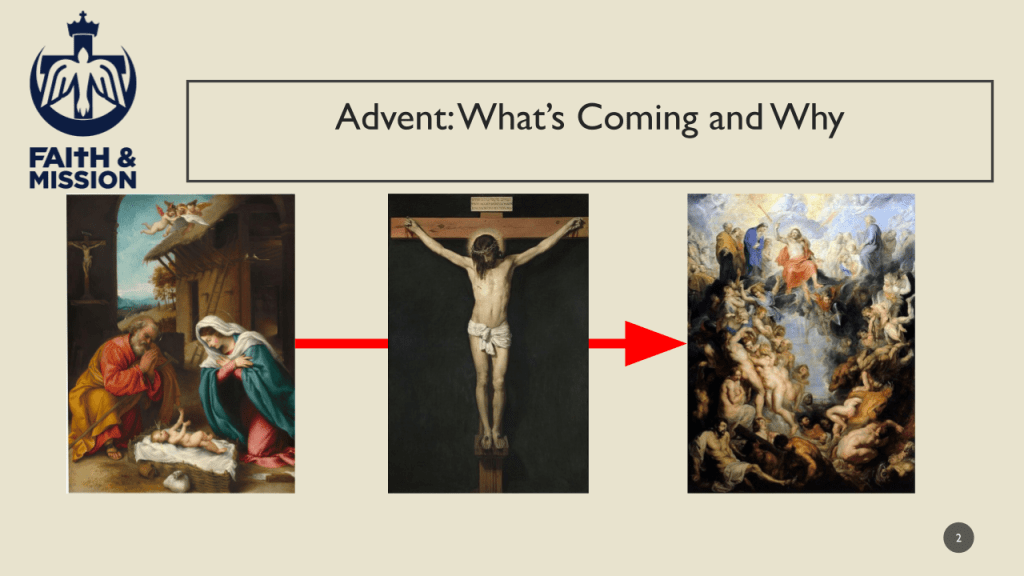
I think if we’re honest with ourselves, we know that we can never really be good enough to deserve heaven. And since there are only two options, that means we deserve the other place. But hope, hope in God’s mercy and hope in his Justice, means that if we run toward his arms he will welcome us into his arms. And he doesn’t care how low we fell or how often we stumbled. You think back to when we were kids and we might be running so fast that we fell over and we laughed and we got back up and ran some more and perhaps we fell again and then we laughed when we got back up and ran some more and finally we got to our mother’s or Daddy’s arms. Our God wants to be that kind of parent to us. And he sent his son to make things right so that we can be like children again and run to his arms.
The gospel stories from the first part of Advent feature John the Baptist. John was the last prophet, proclaiming that the words of Isaiah were coming to pass right then and there. John the Baptist is one of three figures from the Gospels whose birthday we celebrate on the calendar of the church. The other two are Jesus and Mary. All the other saints are memorialized on the day of their death. John, like Mary and Jesus, gets one day for being born and one day for heading home to Heaven. He’s that important to the Gospel message.
In the second joyful mystery of the Rosary, we see that John recognized Jesus while both were still in their mothers’ wombs. John the Baptist is a central figure in Advent because he sees Jesus and recognizes him as his Lord and Savior. Can we recognize that the baby Jesus is coming in mercy at Christmas? He is God with Us, Emmanuel. Our creator makes himself approachable in the second person of the Trinity. Jesus slept and worked and ate, he was tired and hungry and thirsty, just like us. He understands what we are going through, and he reaches out to us in mercy and love. Advent is a time to prepare ourselves to respond to that merciful touch of love. Advent is a time to be alert as John the Baptist was alert. The world thinks we are already in the Christmas season, and the season is spent shopping and eating and drinking. Like John the Baptist, we know Advent is to prepare us for Jesus coming as a baby, coming so that thirty years later he can make the supreme act of mercy and die on the Cross for our sins.
Jesus comes as a baby in a few weeks, and he comes in judgment on the day not yet revealed to us. He is our rightful judge because through his Crucifixion, he is our Redeemer.
Lectionary Comparison
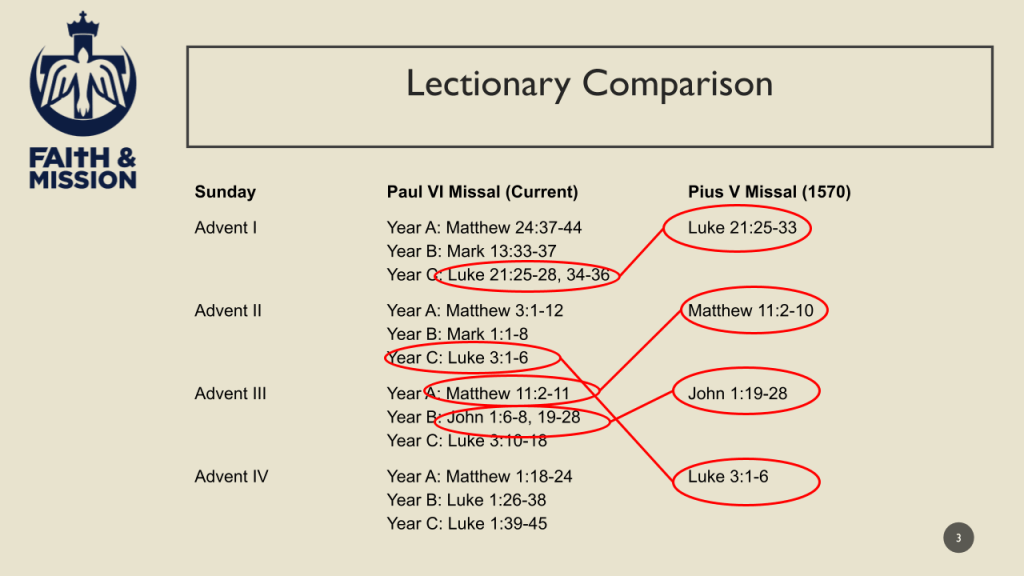
Among the many changes implemented by the liturgical committe after the Second Vatican Council was a revised lectionary. The Council Fathers had asked that there be more readings of Scripture during the Mass liturgy, and the committee responded with a three-year cycle of readings. The purpose of this was to increase the amount of Scripture, to help the faithful hear more Scripture at the Mass. This was a different focus than the old calendar of readings. In the old calendar, there was only one cycle, and the repetition of this shorter list of “greatest hits” was to increase devotion and deeper grasp of the critical teachings.
In adding more readings, the committee also decided to move things around, and this chart shows how the readings for the old calendar are still referenced, but they are not in the same sequence.
First Sunday of Advent
In Year C, which is the year we have just started, the readings from the new calendar and the old calendar are almost the same. They are taken from Luke’s chapter 21, where Jesus is foretelling the end of time. He states clearly that he will come in judgment. So the sense of that Second Coming is very clear in the readings for the First Sunday of Advent.
Collects: First Sunday
Looking at the collect, which are sometimes called the opening prayer, we see similar thoughts expressed with slightly different emphases. The current prayer refers to the faithful in the third person, while the older collect uses the first person plural. There is also an explicit recognition of the issue of sin in the older prayer, while the new prayer hints at that issue by asking that we be “worthy.”
Second Sunday of Advent
The readings for the second sunday make it clear that John the Baptist was a prophet. Remember that the prophet’s job is to say to the people the words that God wants said to those people at that time. John the Baptist is the last prophet, and his preaching echoes the words and actions of the greatest prophet: Isaiah.
Collects: Second Sunday
The two collects seem to be asking for the same gift of understanding and wisdom so as to be good disciples of Jesus. The purpose of these requests is to be able to be with him at the end of time: his Second Coming. The purpose is not explicit, however.
Third Sunday of Advent
In both readings for the third Sunday, the role of John the Baptist is clarified. He is not the prophet-king that Israel has been told to expect. He is the herald of that person – who will begin his earthly ministry by being baptized by John – and his baptism will be more profound than John’s baptism.
The new calendar reading this year is from Luke, and it reflects the practicality we see throughout Luke’s gospel: what do we do, the people ask, and John gives them practical examples of how to live according to God’s plan. The reading from the old calendar is taken from John, and that gospel is written in a very different tone and with a specific purpose. John wants it to be crystal clear who Jesus is – the second person of the Trinity, true God and true Man. The life application is implicit, and it should follow naturally from the sure knowledge of Jesus Christ as Divine, the sacrificial lamb of God.
Collects: Third Sunday
We see the transition to the Nativity – the coming of Jesus in the Flesh – clearly in both collects. It is explicit in the new calendar and implicit but clear in the old calendar. If he’s coming to brighten our minds, then this cannot be his second coming when he comes as Judge.
Fourth Sunday of Advent
In Year C, we get from Luke the Visitation. The timing of this is early Spring rather than Christmastime winter, but it continues the connection between John and Jesus, and Mary is pregnant. That points the reading directly to the Nativity.
In the old calendar, we finally hear of the public ministry of John the Baptist, which we have already heard a couple of weeks earlier in the new calendar in Year C.
So the two readings share the prominence of John the Baptist and his connection with Jesus, but otherwise are very different.
Collects: Fourth Sunday
The general reluctance of the liturgical committee to state plainly the issue of sin is reflected in the two collects for the Fourth Sunday in Advent. In the old calendar we get a direct request for help in overcoming our sins. In the new calendar, we get the prayer we hear in the Angelus, connecting the Incarnation to the Passion and Resurrection. So there is a bit of a difference in tone: one is seeing the glorious end for which Jesus comes at Christmas, and the other asks for help in walking our walk as his disciples.

 Bound in Love
Leave a comment