As a reminder of what we discussed in the Spring, the world around the Church no longer is supportive of the Church’s mission of sharing the good news of Jesus Christ and then living a life in accordance with his teachings. Since the age of Christendom – the age during which the world DID support the Church’s teachings – is no longer with us, we need to return to a posture similar to that of the Church during Apostolic times. That means a call to heroism because living the faith is much harder when the world around you hates the faith. It also means a tolerance for passion among believers because tough times tend to bring out tough people who can handle it, and those kinds tend to alarm us because we tend towards complacency.
The second major topic is the one we will look at this year: are those people around us who tell us to keep our religious views to ourselves really nothing more than followers of another religion? Is there really no middle way available, a path we can follow that lets us live according to the Gospel and lets them live according to their values?
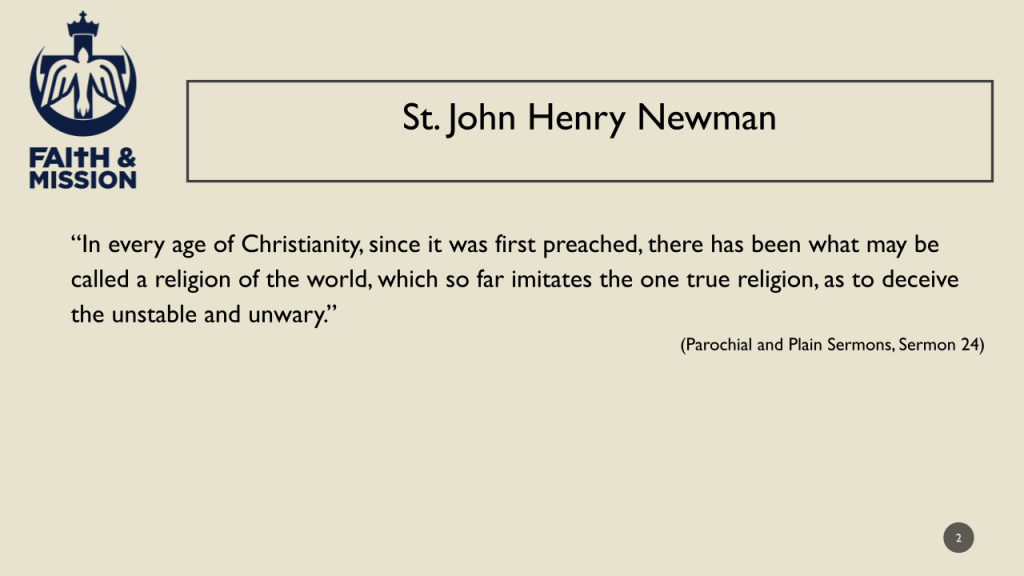
We get the term we are using – religion of the day – from a sermon by an English Catholic saint and Cardinal. He was a convert from the Anglican faith and a professor of the age of the Fathers of the Church.
He made the claim that false preachers have always been present inside the Church, more allied with external opponents of the faith than they will admit. We are certainly aware of the internal threats against the Church in our day, aren’t we?
The Religion of the Day – What is Going on Out There
When we use the word religion, we define it as an ordered system of rights and practices that govern our relationship to the supernatural world and teach us our duties towards God. According to this definition, our society has been growing less religious. But religion can also be understood as the particular set of beliefs and practices that a person or a society holds in order to provide a meaningful vision and narrative for life. Under that definition, there can be religions that deny the existence of God and the supernatural world and yet function for all practical purposes as religions.
We get the word from the Latin language. Latin-speaking scholars argued amongst themselves on the root word for “religio.” The Christian Saint Augustine ultimately chose the verb “to bind” as the root, for we bind ourselves to God as we seek salvation. The pagan philosopher and politician Cicero had chosen the verb “to treat carefully” as the root, which is quite different from binding oneself. One can argue that it’s the difference between the commitment of a covenant versus the clauses in a contract.
Seeking Meaning
Human beings have revealed themselves to be beings that seek meaning. We are unable to live and function, either personally or as a society, we don’t have some sense of why we are alive and what we are living for. We need to settle on a way of looking at the world and our place in it. We need some way of looking that provides hope for the future, that organizes our ethical life, and that points our path forward. It involves a personal commitment to a set of beliefs and moral doctrines and also an embrace of dogmas that cannot be rationally proven but are held with a grip that is much stronger than the mere acquisition of information. If religion is understood in this way then it follows that every person has some kind of religion. And according to that definition of religion, then we are even in the West living in a highly religious age.
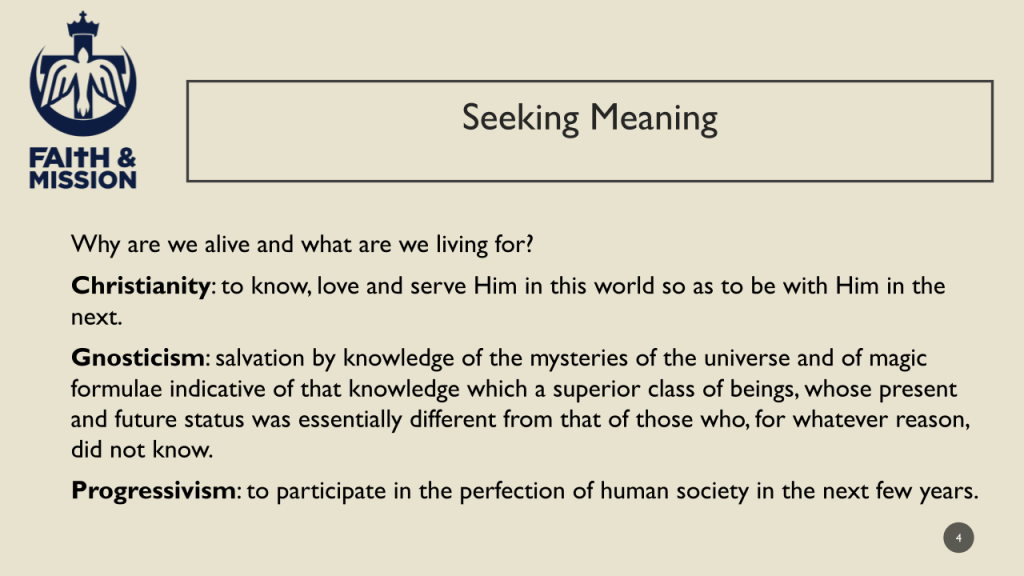
As Catholic Christians we know that the true religion is Christianity. But today, as is true in every age, there is a religion of the day. The author suggests that the dominant religion of the day that is not Christian might be called this: modern neo-Gnostic progressive utopian revolutionary religion. For the sake of simplicity, he will call it progressive religion.
The author argues that this progressive religion is a uniquely potent form of a heresy that has dogged the church from its beginnings: the heresy of Gnosticism. That word comes from the Greek word for knowledge or awareness. In the early days of the church these heretics believed they had been granted a secret knowledge and that the material world was of very little value.
Look at the three definitions: The Christian definition immediately communicates an understanding of the immaterial and eternal world which is our true home and identifies the one way by which we can reach the place we are meant to be. The Gnostic religion is second on this list because it is as old as Christianity and has in various forms been a constant thorn in the side of Christianity. Those who know are by their knowledge of the secrets fundamentally different from those who do not know. The material world is considered less noble than the spiritual world, but there is little in the way of understanding where and how things ultimately end. The Progressive religion – as used by the author – incorporates much of the Gnostic view in a humanistic and materialistic philosophy.
neo-Gnostic Progressivism
There is a strong neo-Gnostic current in modernity, as Catholic observers have noted the past 200 years. We should consider the spiritual principles and underlying assumptions of this modern neo-Gnostic religious belief as they tend to be held and assumed by ourselves and the majority of the people around us so that their dynamics can be better understood. And if we understand them better than we can help those who have been influenced by them especially within the Church to be converted to the Christian gospel.
The arrival of some form of Gnostic religion seems to be the inevitable accompaniment to Christianity wherever it succeeds in gaining significant cultural influence. The more deeply a society has been influenced by Christianity, the more likely it is that it will produce Gnostic variance, and the more potent those variants will be. It is not surprising therefore to find that the last few centuries have seen the development of very potent forms of neo-Gnostic faith, given that Western society and culture have been so deeply influenced by Christianity. Gnostic religion is the classic case of Christianity gone astray.
In the neo-Gnostic atmosphere of our time only a minority are active and self-declared followers of one or another progressive belief system. Even those that are consciously pursuing a Gnostic scheme of salvation seldom call it by that name. But the underlying beliefs provide the foundation and first principles of meaning and moral life for the majority of modern people even if those are unacknowledged or unperceived.

 Bound in Love
Leave a comment