As Catholic Christians we know that the true religion is Christianity. But today, as is true in every age, there is a religion of the day. The author suggests that the dominant religion of the day that is not Christian might be called this: modern neo-Gnostic progressive utopian revolutionary religion. For the sake of simplicity, he will call it progressive religion.
The author argues that this progressive religion is a uniquely potent form of a heresy that has dogged the church from its beginnings: the heresy of Gnosticism. That word comes from the Greek word for knowledge or awareness. In the early days of the church these heretics believed they had been granted a secret knowledge and that the material world was of very little value.
The Christian definition immediately communicates an understanding of the immaterial and eternal world which is our true home and identifies the one way by which we can reach the place we are meant to be. The Gnostic religion is as old as Christianity and has in various forms been a constant thorn in the side of Christianity. Those who know are by their knowledge of the secrets fundamentally different from those who do not know. The material world is considered less noble than the spiritual world, but there is little in the way of understanding where and how things ultimately end. The Progressive religion – as used by the author – incorporates much of the Gnostic view in a humanistic and materialistic philosophy.
There is a strong neo-Gnostic current in modernity, as Catholic observers have noted the past 200 years. We should consider the spiritual principles and underlying assumptions of this modern neo-Gnostic religious belief as they tend to be held and assumed by ourselves and the majority of the people around us so that their dynamics can be better understood. And if we understand them better than we can help those who have been influenced by them especially within the Church to be converted to the Christian gospel.
The arrival of some form of Gnostic religion seems to be the inevitable accompaniment to Christianity wherever it succeeds in gaining significant cultural influence. The more deeply a society has been influenced by Christianity, the more likely it is that it will produce Gnostic variance, and the more potent those variants will be. It is not surprising therefore to find that the last few centuries have seen the development of very potent forms of neo-Gnostic faith, given that Western society and culture have been so deeply influenced by Christianity. Gnostic religion is the classic case of Christianity gone astray.
In the neo-Gnostic atmosphere of our time only a minority are active and self-declared followers of one or another progressive belief system. Even those that are consciously pursuing a Gnostic scheme of salvation seldom call it by that name. But the underlying beliefs provide the foundation and first principles of meaning and moral life for the majority of modern people even if those are unacknowledged or unperceived.
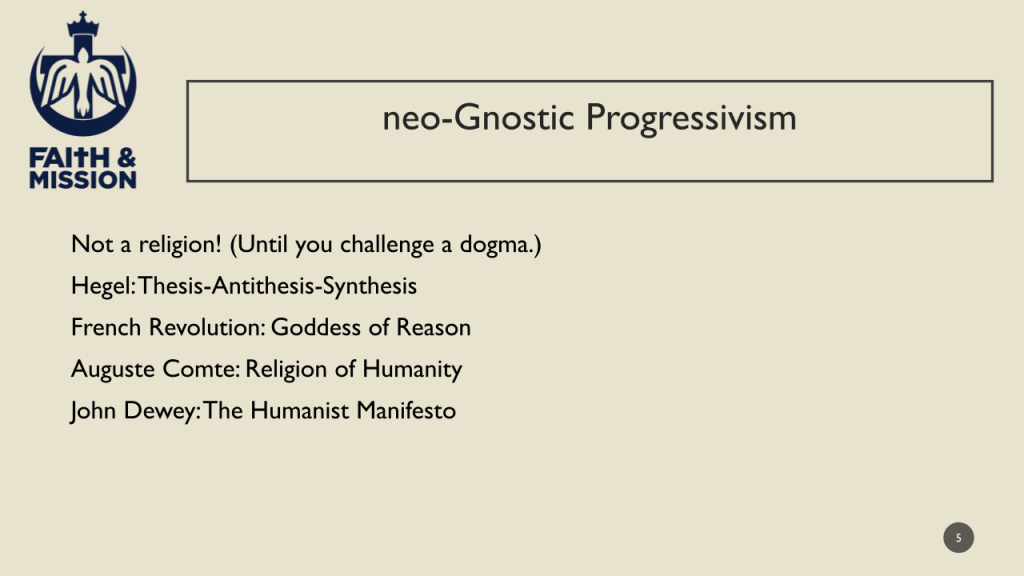
Not a religion
An unfortunate aspect of modern progressive religion it is not usually recognized as a dogmatic faith by its followers. Many of these modern progressives would describe themselves as rational, scientific, and non-religious. But challenge them on a core opinion, and you will run into a grip as tight as any faithful Christian would hold to the dogma of the Trinity. The problem with this state of affairs is not the religious nature of their beliefs. It is rather that by denying their own views as religious and therefore as having the quality of dogma, they are unable to exercise the kind of thoughtful investigation of dogma necessary for any intelligently held religious faith. This means that they are unable to distinguish the kind of knowledge gained by religious assumptions from other kinds of knowledge. They then demand that religious considerations be left out of all of the questions of the day, not realizing that they are promoting and often coercing the practice of their own religion upon others under the false guise of being religiously neutral.
A German philosopher named George Hegel introduced a way of thinking that was adopted and adapted by later Progressive thinkers. He took the ancient Greek idea of dialectic, or dialogue, and suggested the proposal of something, followed by a counter-proposal, and then a working out of the solution was how truth evolved. This came to be known as thesis, antithesis, and synthesis. In the non-Christian philosophies, this is like a ratchet of progress: it never goes back and re-considers the thesis or the antithesis but uses the synthesis for the next ratchet of dialectical progress. This foundational view infects all of Modern thinking. We see it even in the Catholic Church from people who think the most recent ecumenical council eliminates the importance of the teachings of the councils held before it. Each step in the Progressive dialectical sequence erases the previous step. This means we can never go back. This is fundamentally opposed to Christian philosophy, which is grounded in the self-acceptance of limited knowledge due to the Fall of Man.
In the past, some theorists of modern progressive belief understood more clearly that they were putting forward a new religion. They sometimes recognize that it was a secular religion that did not have a divinity or any metaphysical concepts. In the radical phase of the French Revolution, the revolutionaries created an entirely new calendar, with a whole round of religious feasts that enthroned the goddess of reason in the Cathedral of Notre Dame in Paris. The founder of the science of sociology, a French man named August Comte, called for the entire replacement of Christianity by a new faith that he called the religion of humanity. In the United States, John Dewey was an important leader of the development of public education, and he helped write the humanist manifesto, which argued that a new humanistic religion was needed to replace the old supernatural one. In the modern age with constitutions that do not allow for the official establishment of any one religion, these progressives quickly dropped religious language from their writings.

 Bound in Love
Leave a comment