An unfortunate aspect of modern progressive religion it is not usually recognized as a dogmatic faith by its followers. Many of these modern progressives would describe themselves as rational, scientific, and non-religious. But challenge them on a core opinion, and you will run into a grip as tight as any faithful Christian would hold to the dogma of the Trinity. The problem with this state of affairs is not the religious nature of their beliefs. It is rather that by denying their own views as religious and therefore as having the quality of dogma, they are unable to exercise the kind of thoughtful investigation of dogma necessary for any intelligently held religious faith. This means that they are unable to distinguish the kind of knowledge gained by religious assumptions from other kinds of knowledge. They then demand that religious considerations be left out of all of the questions of the day, not realizing that they are promoting and often coercing the practice of their own religion upon others under the false guise of being religiously neutral.
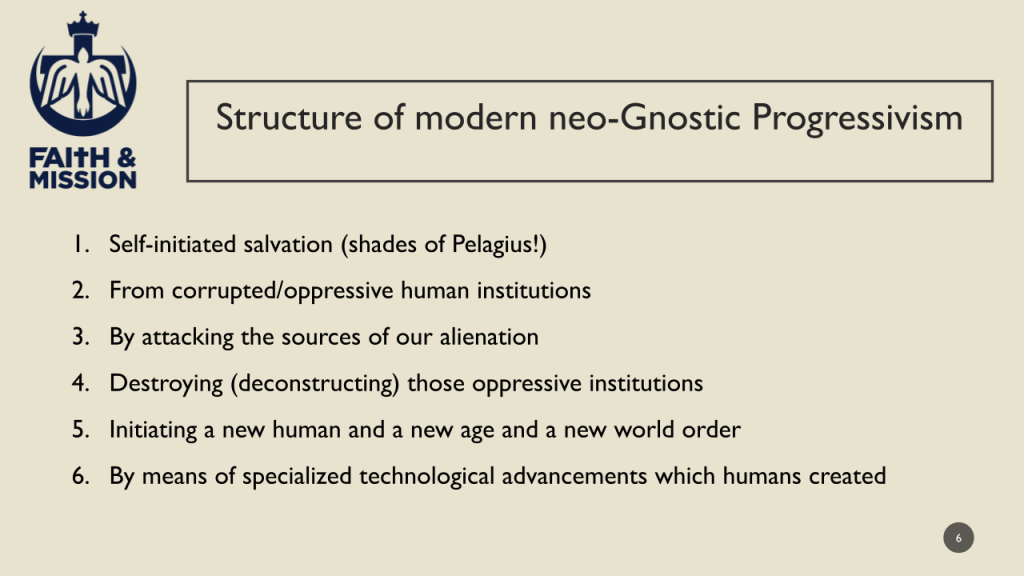
A German philosopher named George Hegel introduced a way of thinking that was adopted and adapted by later Progressive thinkers. He took the ancient Greek idea of dialectic, or dialogue, and suggested the proposal of something, followed by a counter-proposal, and then a working out of the solution was how truth evolved. This came to be known as thesis, antithesis, and synthesis. In the non-Christian philosophies, this is like a ratchet of progress: it never goes back and re-considers the thesis or the antithesis but uses the synthesis for the next ratchet of dialectical progress. This foundational view infects all of Modern thinking. We see it even in the Catholic Church from people who think the most recent ecumenical council eliminates the importance of the teachings of the councils held before it. Each step in the Progressive dialectical sequence erases the previous step. This means we can never go back. This is fundamentally opposed to Christian philosophy, which is grounded in the self-acceptance of limited knowledge due to the Fall of Man.
In the past, some theorists of modern progressive belief understood more clearly that they were putting forward a new religion. They sometimes recognize that it was a secular religion that did not have a divinity or any metaphysical concepts. In the radical phase of the French Revolution, the revolutionaries created an entirely new calendar, with a whole round of religious feasts that enthroned the goddess of reason in the Cathedral of Notre Dame in Paris. The founder of the science of sociology, a French man named August Comte, called for the entire replacement of Christianity by a new faith that he called the religion of humanity. In the United States, John Dewey was an important leader of the development of public education, and he helped write the humanist manifesto, which argued that a new humanistic religion was needed to replace the old supernatural one. In the modern age with constitutions that do not allow for the official establishment of any one religion, these progressives quickly dropped religious language from their writings.
Maximilian Robespierre’s men were carrying out drownings, guillotines and lynching of Catholics both lay and clerical. Even bishops were among those brutally killed as the French Revolution sought to destroy everything good and pure about the old world, remaking a new one.
They removed statues of Our Lady from Notre Dame and other cathedrals, replacing her with those dedicated to the Cult of Reason. They renamed the months of the year. They created 10 instead of 7 days in a week.
As the bloodthirsty Masonic Parisian rapist atheists ripped through France, imposing their ‘revolution’ on the people in the Reign of Terror, it was Catholics who bore the brunt of the viciousness.
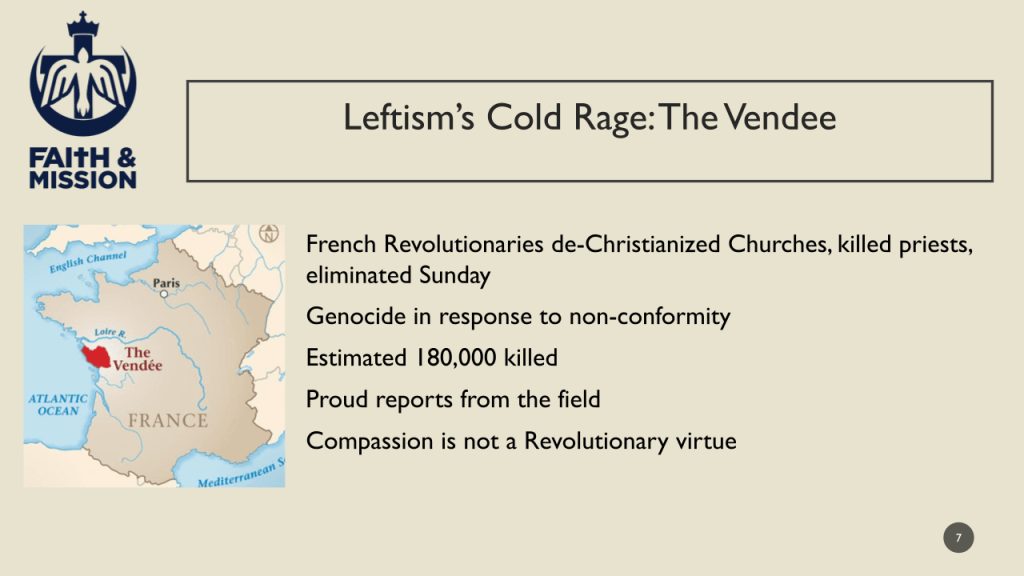
When the French Republic instituted the Civil Constitution of the Clergy, demanding obedience from the church, it began a chain of events that would result in the massacre of thousands of Catholics in the Vendee. Churches closed, altars were desecrated and the traces of Catholicism were erased as far as humanly possible.
For the population of the Vendee, this was something that they could not accept. When they were drafted into the Revolutionary Army, they refused. Soon, priests were among those who were leading a rebellion against the Masonic Reign of Terror.
Although they pioneered new forms of guerrilla warfare in their efforts to keep the savages of the Revolution at bay, the Revolutionaries tried new tactics too, tying clergy and nuns up and drowning them together in ‘marriages’. They locked children in churches and set them on fire. Women were raped and murdered in large numbers, as a weapon against forming future enemies of the Revolution.
After a battle between 150,000 Revolutionary Army troops and 80,000 farmers and peasants, the revolutionaries began a killing spree of innocent civilians that can best be described as wholesale genocide against the Catholics of the Vendée. By the time the butchery ended, 170,000 inhabitants of this Catholic heartland in western France had been killed, women and children as well as menfolk.
One revolutionary officer was pleased to report he had found a more efficient means of mass execution through drowning up to 3,000 people at a time in order to save bullets.
General Francois-Joseph Westermann reported to his superiors in Paris:
The Vendee, republican fellow citizens, no longer exists. She is dead under our sabers, together with her women and children. I have just buried her in the swamps and forests of Savenay. Following the orders you gave me, I have trampled the children to death with our horses. I have massacred the women, and they are no longer going to give birth to any more brigands. I am not guilty of taking a single prisoner, I have exterminated them all. … The roads are covered with corpses. There are so many of them at several places they form pyramids. The firing squads work incessantly at Savenay since every moment brigands arrive who pretend they will surrender as prisoners … but we are not taking any. One would be forced to feed them with the bread of liberty, but compassion is not a revolutionary virtue.

 Bound in Love
Leave a comment