The progressive religion is one that:
- Issues a high and compelling moral call
- Promises to overcome the aching sense of not fitting into the world
- Looks toward a glorious future of increasing perfection
- Has an adventurous edge and issues a decisive call to action
- Appeals to the inventive capacity of the human mind to solve problems and to improve existence
- Dissolves the believer of personal guilt
- Echoes the truths of Christianity in ways that appeal to our created nature and respond to certain desires given to us by God
Like many deceptive things, its darker side is not immediately apparent. We have to understand the attractiveness of the progressive religion in order to consider how to counter its influence in our own lives and in the wider society.
The Gnostic outlook through history
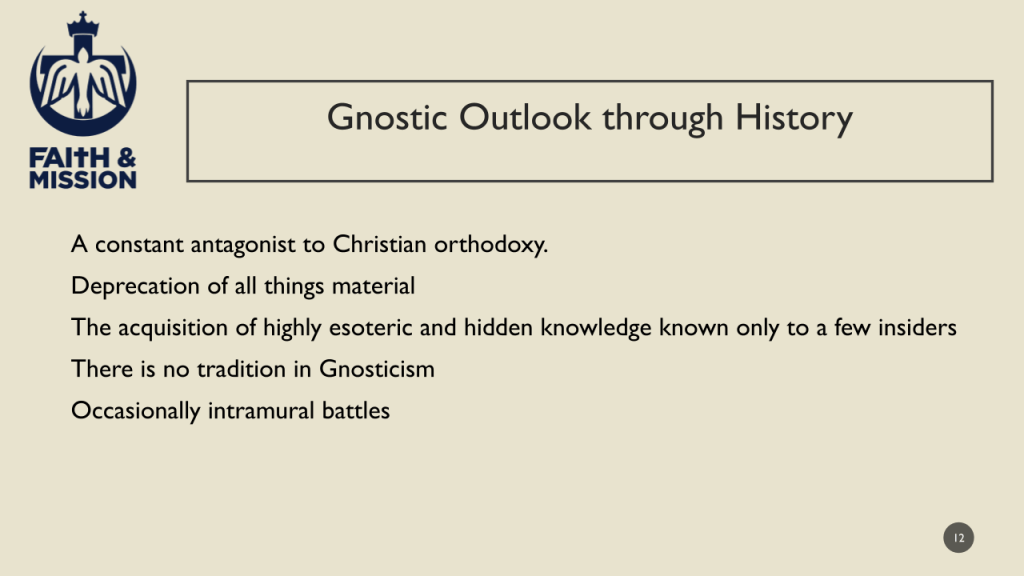
As we have noted already, Gnostic belief systems have been a constant antagonist to Christianity from its beginnings. Simon Magus in the acts of the apostles approaches Christianity with a Gnostic mentality: he wants the apostolic power to use for himself. We’ve already mentioned Marcion. A century later, St. Irenaeus, Justin Martyr and Tertullian viewed Gnosticism as the greatest threat to the church. In the fourth century, St. Augustine spent many years as a member of the Gnostic sect known as the Manichaeans before he turned to Christianity. St. Dominic was asked to establish the order of preachers to fight the Albigensians, who held a form of Gnostic faith. See Thomas Aquinas wrote many arguments against the Gnostic errors of his day. The Protestant Reformation gave an opening to certain religious sects and currents of thought with Gnostic propensities, especially those associated with the more radical forms of Puritanism. Gnostic attitudes can be seen in the development of modern theologies of liberation that have emerged mainly in Catholic settings. And a good deal of what goes loosely by the name of liberal Christianity is fundamentally Gnostic in its structure.
So dressed up in different ways at different times, the principles that underlie the Gnostic attitude are similar in every age. The two primary qualities are a deprecation of all things material, and the acquisition of highly esoteric and hidden knowledge known only to a few insiders. There is no tradition in Gnosticism; the believers of one age have not usually been dependent upon those of a previous age for their beliefs and ideas. It almost always grows out of Christianity, and it may be thought of as growing whenever Christians grow collectively proud.
Much of the thought that came out of the Enlightenment can be understood as variance of the Gnostic attitude, since the Enlightenment itself grew out of Christendom. From Francis Bacon to Isaac Newton to Jean-Jacques Rousseau, and George Hegel, there is a regular connection of atheistic philosophical inquiry that wraps itself in rationality in order to avoid any faith in God.
Karl Marx reworked Hegel’s philosophy into a powerful expression of revolutionary religion. The 20th century movements of fascism and Nazi-ism are fundamentally Gnostic. And in the post world war period, this neo-Gnostic religious stance can be discerned as the deep structure of modern movements such as radical feminism, sexual liberation, the green movement and trans-humanism.
There is from time to time intramural fighting between these neo-Gnostic progressive religions. Nazi-ism was opposed to Soviet communism politically while their underlying philosophy was drawn from neo-Gnostic principles. The two are blood brothers founded on similar first principles, as can be seen by the outcome of their ideas whenever they are put into practice. It is not accidental that Mussolini, the founder of modern Fascism, was a disciple of the Bolshevik Lenin. We see a similar battle brewing between radical feminist and the proponents of the trans-movement.
The derivative nature of Gnostic faiths
Gnostic belief does not resolve itself into one consistent set of practices or institutional arrangements. It is rather a stance, a way of thinking, founded on key first principles but expressing those principles in many different ways. This means that Gnosticism is inherently parasitic, it must develop from a host and is derivative rather than original.
Much of the power of a given Gnostic belief system comes from what it has borrowed from an existing and internally more coherent way of seeing things. The inherently derivative nature of Gnostic attitude means that an existing religious system can be moved in a Gnostic direction to a greater or lesser degree. It is not a complete change as in the case of a Christian becoming a Muslim, but a gradual corruption that results in a real change. Words, institutional offices, concepts, and narratives are given new meanings but are left superficially in their original form. The amorphous nature of Gnosticism explains something of the church’s constant vigilance against various forms of Gnosticism throughout its history. Since it is a parasite, it never makes a frontal and external assault. It takes root subtly within the church and claims to offer the true meaning of the Christian faith even as it is subverting its foundations.. In his great work called against heresies, St. Irenaeus said of Gnostics: “they talk like us, though thinking very differently.”
Because it is derivative, and because of its own internal inherent contradictions, it is a futile task to look for logical consistency in a Gnostic worldview. Marxist communism, the most thorough attempt at constructing a completely coherent gnostic scheme, was still dependent for much of its attractive power on the Judeo-Christian faith that preceded it. Marxism has proven to be an incoherent and destructive failure whenever it has been put into practice.

 Bound in Love
Leave a comment