How does the neo-Gnostic religion map onto the current political landscape? Is this just a different way of characterizing leftist liberal politics? Are there Neo-Gnostic expressions of faith on the right as well as on the left?
Despite any claims that they are completely separate, even in America religion and politics have always been intertwined in important ways. The American founders did not want to do away with religion; they wanted to do away with an established state religion. Even among the non-believing founders, there was recognition that religion was a useful means of engendering moral virtue in the population.
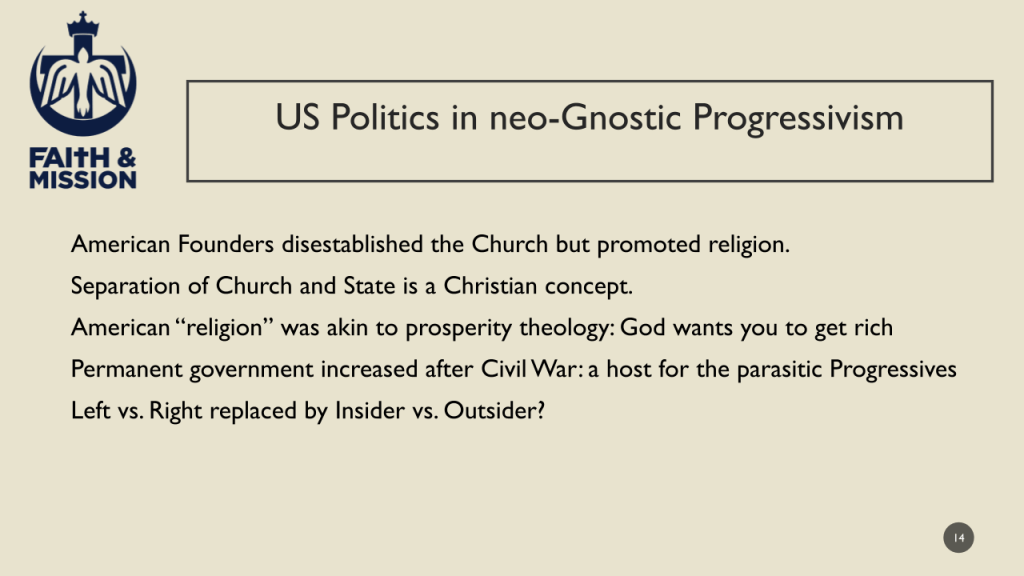
Remember that most of the world’s civilizations and cultures have put spiritual, moral, and political authority in the same office. Priestly kingship in some form has been the overwhelmingly favored type of human government through the ages. Remember from our study of Islam that the Persian faith was a political-theological combination, and Islam took on that characteristic when the center of the Muslim empire moved closer to Persia. Islam is in most of the world as much a political philosophy as a religion of faith. Jesus changed all that, as Mark 22:21 shows: (give to Caesar what is Caesar’s, and to God what is God’s.” In Christian civilizations, it has been held that there are two distinct authorities governing human life: a spiritual authority and the temporal authority. It has been recognized that state should not be subject in strictly temporal matters to spiritual authorities. The Pope isn’t supposed to set the bus schedule. And likewise the church should not be relegated to a mere Department of State. The church’s primary job is not the housing and care of illegal immigrants, for example.
We should expect that as our society increasingly distances itself from its Christian roots, the Christian sensibility for limited government will decline, and the universal human tendency to unite all authority in one central office or structure will reassert itself. This development has been progressing in fits and starts all over the Western world since the French Revolution. Once a Christian vision of the world has been abandoned, it is very difficult to limit the power of temporal governments. Given the fact that modern progressive religion is overwhelmingly focused on this world, the political arena has increasingly become the staging ground for religious propagation and a kind of religious warfare, even though its participants persist in denying the religious nature of their political visions.
The labels left and right actually come to us from the seating in the national assembly at the time of the French Revolution, but they have lost most of their meaning through the centuries. And as we have already noted even though Soviet Communists are usually shown as an opposition to national socialists, therefore left versus right, the reality is it was a civil war between Gnostic religions.
In the United States the right traditionally was close to the 19th century English liberal tradition, tending to promote freedom of markets and favor less government regulation. After the Civil War, especially after the closing of the American frontier, the administrative apparatus of the federal government grew. Most of the super-rich Americans like Cornelius Vanderbilt, John Rockefeller, Andrew Carnegie, and JP Morgan got rich by manipulating legislatures and stock market speculation. This naturally led to a response, and the American Progressive political movement appeared.
The American left espoused a greater role of government in addressing social and economic questions. In the current political climate, there is some recognition that left and right no longer accurately describe the situation, and that perhaps insider and outsider is a more apt description. The concept of insider elites is consistent with a neo-Gnostic religion. But on the right and even among the outsiders, there can be a temptation to identify a potential Savior who can fix everything that’s wrong with the world here and now in the world.
Christians should never forget that our most significant battleground is not politics for the legislature but the individual human soul. The battle against the devil in our personal lives is more serious than the battle in the political sphere.

Two academics in 2005 coined the term “moralistic therapeutic deism” to describe the predominant beliefs of American teenagers they had surveyed. They found five core tenets:
- A God exists who created an order of the world and watches over human life on earth.
- God wants people to be good, nice, and fair to each other, as taught in the Bible and by most world religions.
- The central goal of life is to be happy and to feel good about oneself.
- God does not need to be particularly involved in one’s life except when God is needed to resolve a problem.
- Good people go to heaven when they die.
This formulation has gained a lot of attention, and it quickly became obvious that moralistic therapeutic deism was not just the belief of millennial teenagers but was characteristic of whole swaths of the Christian world.
The prevalence of this approach to Christianity represents a degenerate and weak state of Christianity that is highly vulnerable to the preaching of a more potent and virulent neo-Gnostic faith. Why is MTD so prone to embrace neo-Gnostic beliefs? — Find out next week!

 Bound in Love
Leave a comment