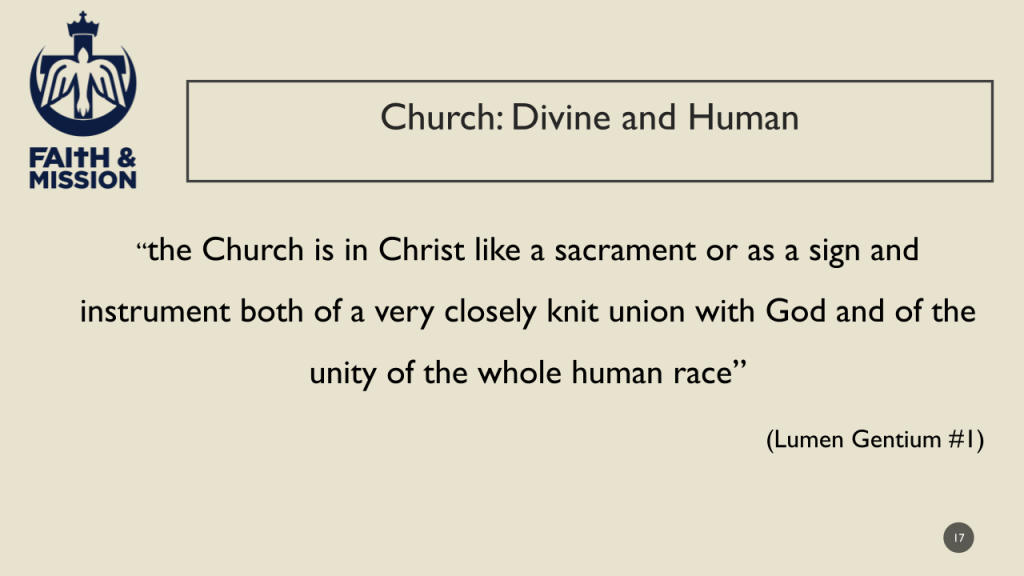
We meant to continue to talk about how the Church is not simply a human-level non-government organization even if it is a large government contractor, but somewhere along the way we got to talking about Purgatory. (We go where the Spirit leads.)
Because the church is set up as a heavenly society in the midst of a fallen world, its members necessarily face the temptation of conforming themselves to patterns of fallenness rather than obeying God’s heavenly ways. From time to time God has allowed a certain measure of darkness to afflict portions of his own people, and then he has used that to sharpen the faith and the fighting spirit of his true servants. In words attributed to St. Teresa of Avila, “God writes straight with crooked lines.” The dark betrayal of Judas in the passion became a part of Christ’s plan to bring light to the world. We need to be open to mystery in the church today just as it was operating at the time of Jesus.
Think of Israel, God’s chosen people. They were set apart, a holy priesthood, if they were put in the land of Canaan. They were supposed to stay pure, but they allowed themselves to be corrupted by the practices of the world in which they lived. God would send a prophet to preach the good news, and sometimes it took at least for a little while. They asked him to give them a king so that they would be like other nations, and he granted them their desire but warned them they really would not like it. They so continuously lost their focus on him and got caught up in worldly politics and striving and contesting with each other, that God allowed them to be almost entirely destroyed and sent away in the Babylonian captivity. That hard lesson helped them see that whatever else they were, they were not an earthly kingdom. They were never a free nation after they returned from Babylon.
The church is the new Israel, and from time to time it has lost its sense of who it is. It has gotten caught up in worldly currents, which are not central to its mission.
Interior Battles
It’s always important to remember that God wins. So if we stay close to him, we win also. But the battle continues to be fought even inside the church. Judas was not the last betrayer. Arius was not the last heretic. It is precisely within the church that we are meant to fight a zealous and determined battle for truth and goodness.
So while we need to of course fight external enemies of the church, and we need to fight against internal agents of the enemy inside the church, the primary arena of spiritual battle is the struggle within ourselves against darkness in our own minds and hearts. Our most pressing practical concern in waging the spiritual battle is to ask how we might be more deeply converted in thought and action to the truth of Christ and become even more free from the false Gospels that surround us.
A different Gospel
The most obvious expression of the disease of progressive religion inside the church is found in those who profess to be Christian but have abandoned key doctrines of the faith and have embraced some form of the neo-Gnostic gospel of personal self creation. When we encounter these people in the church we need to understand that they are no longer Christian in any meaningful sense even as they continue to use Christian language and maintain membership and even positions of responsibility within the church. Most of us are not in a position to seriously address this problem, and God is probably not calling us to this fight. We need to recognize that we can easily be distracted by it from the more pressing battles that are closer to our own homes. But we need to be able to see it for what it is.
Soft pedaling the fall
Serious Christians do not usually explicitly deny the doctrine of original sin, but under the pervading pressure of progressive dogma, the reality of being fallen and the consequences that necessarily stem from that reality often cease to operate as living truths for us. We can unconsciously assume the progressive dogma that people are fundamentally good. The church teaches that people are fundamentally good and that they are made in the image and likeness of God, but it insists that we wounded that goodness through the fall.
Acknowledging the reality of the fall, and letting that reality be at the forefront of our minds as we go through our day, is the path of humility. We’re not saying that we are worthless piles of trash, but we are acknowledging the deep and lasting wound that we all carry. Paradoxically, acknowledgment of the wound ennobles the effort to walk and grow in spite of it, to overcome it by making our peace with it and finally turning it over to our Creator.
The Myopia of Secularity
Since we are earth-bound and only live 70 or 80 years on average, we can lose sight of the breadth of the Church. Our time on Earth is a time of preparation for our real life. It can only be fully understood in that context. Since modern Progressives do not account for an afterlife, this life is all that there is. Heaven is reached during our lifetimes, according to them.
It is easy for Christians to get caught up in short-sightedness in a culture that is present-focused. Under an assault of sensual and informational distraction, we can be caught by the illusion that puts physical health ahead of spiritual health. We can be afflicted by the blindness that views human suffering and tragedy in this world as final and irreparable. It can lead us to retranslating the Gospel into a temporal recipe book for worldly problems of injustice and poverty.
If we succumb to this pressure, we can lose our confidence in the afterlife that lessens our fear of death. Christians know that Heaven or Hell awaits every person at their death, but Progressive religion puts the focus on this life because it denies the reality of eternity. The calm and courageous witness of Christians facing death for their faith was one the most powerful tools of conversion in the Roman empire. Many martyrs were followed by their jailer who converted on the spot seeing the peace with which the Christian faced torture and execution. Progressives dismiss these stories as ancient myths.
Seeing the world with dualistic eyes
The progressive religion sees two radically distinct kinds of humans: the good people, or those who have embraced the correct progressive dogma, and the evil people, or those who are standing athwart the progress of humanity. Lately that second group has been called deplorables.
Christians who live in a progressive religious environment can become infected with the same dark dualistic error. Whereas Christ tells us to take the evil people and convert them, the progressive faith says they should be discarded because they are unfixable. Within the church we can come to think that if we could just eradicate those bad people from the church, we would finally become the pure and holy body we wish to be. Think of the contrast between the Pharisee who prays thanking God that he’s not like the other guy and the tax collector who prays with humility. When Jesus tells that parable, he is clearly telling us that we should be like the tax collector rather than like the Pharisee. The progressive religion is filled with Pharisees.


 Bound in Love
Leave a comment