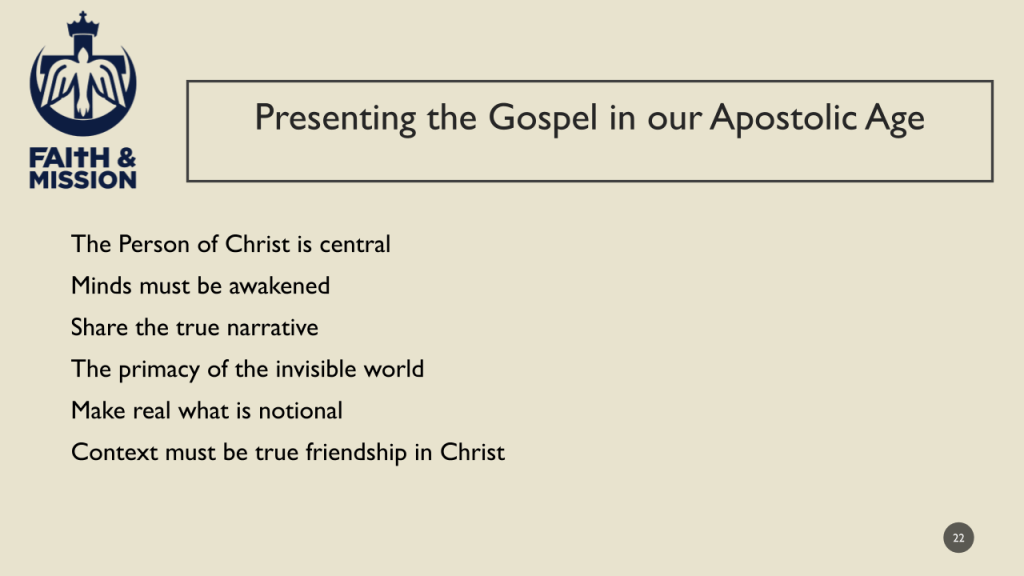
Here are some suggestions that might inform how we present Christ and the Christian faith in light of our current cultural world. None of these is new, but they may need greater emphasis at this time.
The centrality of the person of Christ
The only answer to the identity crisis the world finds itself in, feeling lost and alienated and oppressed, is coming to know Jesus Christ. All the many facets of our faith are centered on one great foundation: the person whose name is Jesus. To be a Christian is to belong to Jesus, to know him, to be in union with him, to become a part of him. Christ is the absolute center, the beginning, and the end. Our time needs once again to be amazed and overwhelmed by Christ himself.
The importance of awakened minds
If Jesus is someone we need to get to know personally as brother, master, king, and friend, he is also someone we need to encounter as the wisdom of God who enlightens our minds. He said himself that he came to bear witness to the truth. An apostolic time demands of every Christian and instructed intellect. We need to receive instruction from Christ. The Catholic intellectual life is a vast storehouse of riches, and modern technology makes it extremely accessible to us. We need to dig into that storehouse and awaken our own minds.
The necessity of the true narrative
The early evangelists as recorded in the acts of the apostles all shared the same approach. They told the story of salvation. They preached Christ, but they did so in the context of the overall narrative that made his significance crystal clear. Much of what it means to be converted to the Christian faith is to embrace the true narrative of humanity. We need to reinvigorate our grasp of this true story, that it is an epic saga of high drama, and that it is also the story of each human person’s individual life, and that it is the only story that will provide the meaning we are all so desperately seeking.
The primacy of mystery in the invisible world
In the Christian sense of the word, a mystery is not something we do not happen to know; it is something we cannot know in full because it is beyond the grasp of our limited minds. That is why we speak of the mystery of the Trinity, or the mystery of the incarnation, or the mystery of the Eucharistic presence of Christ. How our human nature is made up of both bodies and souls is another mystery. If we are to be in relation with an infinite God, we need to be ready to face mysteries. This means coming alive to the realities of the invisible world. Neo-Gnostic progressivism wants nothing to do with mystery or an invisible world. Yet the human soul knows somewhere in its depths that the visible measurable world is not all there is. Our age is starving for the mysterious and the invisible. Finding ways to call ourselves and our age back to the unseen and mysterious world is an important task for our time.
Making real what is notional
Those who have grown up in a transitional time like ours often possess a good amount of abstract knowledge about Jesus and the Christian faith. We know lots of Bible stories, and we may have learned a lot of the basic Christian doctrines. This is notional knowledge. It needs to become real. It needs to become alive. It needs to be a living truth that guides the inner person and points out the way forward in life. It is necessary to engage the imaginative faculties to drive home ideas and help them to come alive. Jesus often taught and imaginatively powerful parables. He used images and metaphors that caught your attention and they drove home powerful truths. Just think of what you take away from hearing the parable of the prodigal son, and often you take away something new each time you hear the same parable.
The proper context is true friendship in Christ
We know that the Christian faith is not simply an individual pursuit. God has counted the very hairs on our heads. At the same time, he draws us into a corporate life so that in our earthly lives as Christian pilgrims we can in some mysterious way have some connection to the communion of love that is the Trinity. St. Paul describes the church as parts of the body. We live in a time of increasing personal isolation, where superficial relationships are the order of the day, yet the human heart longs for genuine communion with others.
Christ makes such communion possible. Genuine friendship is a supernatural outgrowth of the life of Christ in each of us. Christians are joined to each other in ways that go beyond our natural abilities for union with each other. This opens up possibilities for a very deep kind of friendship.
The most effective witness to the life of Christ will come more likely in a group of people than through a completely individual witness. Many will be drawn to Christ by meeting a group of Christian friends, or by getting to know the Christian family. They will recognize a deeply attractive quality among those they are getting to know.
Conclusion
The opening of John’s Revelation speaks to the reader about the tribulation and patient endurance. That is a strategic posture of standing while waiting for the Lord, defeating the enemy by persevering in truth and love until the appointed time. That posture the John speaks of is true for every age and every time. It is particularly important during those times when the Christian gospel is under intense attack — a time such as ours.
Standing firm, we can walk forward confidently even as we are attacked and persecuted for our faith in Jesus. Understanding the limits of the neopagan progressive religion, we can minister to these lost children with love. Just as you don’t embrace the craziness of a crazy man when you talk with him, we won’t embrace the false religion of these neo-gnostics when we talk with them. We will rest in the love of Christ, and we will rest in the truth of Christ, and we will offer the victory of Christ to those who truly want it.

 Bound in Love
Leave a comment