We’re going to talk about the dogma of the immaculate conception, but it requires us to make our peace with an understanding of the predestination of Mary and her human son Jesus.
What we mean by predestination is that we need a way to understand God’s action in the created world given that God is eternally without past or present but the world exists in time. The church uses the phrase “economy of salvation” when it’s talking about the eternal God operating in the constraints of time and space. The only way that we can have an economy of salvation and an order of finite realities outside the creator is if we count on the predestination or the order between various intentions determined by divine mercy and goodness. So it is predestination — especially of the birth of Jesus through Mary — that can make sense of why it seems when we read the creation story God the father seems to have made a few things that aren’t really good or he made some kind of a mistake or he’s not really all powerful and all good. The Orthodox Christian response to those types of complaints or accusations is to say that God willed us to do the good and gave us free will and knowing we would abuse that freedom had already planned or predestined our salvation through his only begotten son.
Predestination of Mary
So it is predestination that helps us make some sense of Mary’s immaculate conception. Unlike every woman except Eve, Mary is conceived without concupiscence, the residual stain of the original sin committed by Adam and Eve. Mary with her immaculate conception, especially opposed to all of us with our “maculate” conceptions, is an image of the relation between creation and grace or between creation and predestination to grace and glory in Christ in the order of finite realities outside of God. The mystery of grace is primarily the mystery of the grace of the incarnation. And that mystery is tightly linked to the grace of the immaculate conception, which is the unique personal sanctity of the mother of the Savior God. So Mary the Virgin mother belongs to the economy of salvation — that is the working out of God’s plan in the creation — as one of the saved redeemed, and she alone also pertains to the order of the hypostatic union — the fact that in Jesus Christ we have the divinity and humanity or two natures — because as the immaculate conception or “full of grace,” she is capable of being the virgin-mother of God.
Mary’s only reason for existence is to be full of grace and Christ’s mother, and he would come to be incarnate only through her because she is immaculate. All of this would come to be, not by necessity of nature, but by the good pleasure of the father. So this fittingness “that this all seems right and proper” is far from being irrational and arbitrary but is the source of all rationality in creation. By her immaculate conception, Mary and Mary alone is appropriately equipped to be the Theotokos.
Why the predestination of Mary is important
According to almost all the fathers of the church, the divine plan of salvation is central to the interpretation of the first words of the Bible: “in the beginning” (Genesis 1:1). These words, according to the fathers, are not speaking about a first moment of time but actually prior to time at the first point in God’s eternal councils namely the incarnate Word, son of Mary. The first point of those councils is that God created heaven and earth for the sake of Jesus and Mary. This is why the first man and woman, the high point of the work of six days, were formed before the fall and in a spousal context. Marriage as a divinely instituted covenant between Adam and Eve typified — that is prefigured — Christ and Mary, and through Mary, Christ and the church. The absolute primacy of Jesus and Mary constitutes the basis for both the possibility of redemption from the tragedy of the fall and for the perfection of that redemptive work, namely Jesus is most perfect. Mary in some intrinsic manner pertains as no other person to the order of the hypostatic union, the grace of Grace’s and source of all order and intelligibility both in the economy of salvation and in creation. This predestination also helps to explain why it is logical that when the Archangel Gabriel approached Mary, he gave her the title, “full of grace.” She was from before time predestined to be like Eve, full of grace and without the stain of sin.
The Fact of the Immaculate Conception
Mary’s titles Most Holy (Sanctissima), All Blessed (Beatissima) are from the earliest days of the Church and from Scripture. Gabriel addresses her “the Lord is with you, blessed are you among women” indicating the fact of her special relationship with God. St. Elizabeth, her cousin, says at the Visitation, “blessed art thou amongst women,” which echoes the Archangel’s salutation.
The fact of the Immaculate Conception is implicitly rooted in the truth of the absolute primacy of Christ and revealed in texts such as Genesis 3:15, Luke 1:28 and Revelation 12:1ff. These deal with the fulfillment of a precise promise of salvation involving a woman in no way – even slightly – tainted by the dominion of the serpent in the Garden – the Devil.
The conception of Mary was from the very early days celebrated in the East as a feast because it was recognized as the first dawn of a new order, the order or economy of salvation, of a new humanity, as the indispensable introduction to the Incarnation. Mary’s immaculate is the same immaculate St. Paul references when explaining the love Christ has for his Church. (Ephesians 5:27 – “That he might present it to himself a glorious church, not having spot, or wrinkle, or any such thing; but that it should be holy and without blemish.”)
Grounds for the dogma in revelation
Mary’s unique condition as the “All Holy” – this title dates from the end of the second century in Egypt. As such, she is the woman who undoes the tragedy stemming from the disobedience of the first Eve. She is the New Eve, and her conception is the moment of her creation. (Like Mary, we celebrate the conception of Jesus on March 25, the Feast of the Annunciation.) There was universal agreement on this point from the Council of Ephesus (431 AD) until the Protestant Reformation. By the time of St. Andrew of Crete (660-740), the sanctity of Mary at conception (her total exemption from the power of Satan) is being expressly affirmed. In the West, doctors such as Jerome, Ambrose, and Augustine were defending this dogma from four points of attack:
- Some denied Mary’s virginity during childbirth
- Some denied that virginity was superior to marriage
- Some denied the divinity of the child of Mary (Jesus)
- Some denied the essence of grace as distinct from nature
They argued against these attacks and preached that Mary is the virgin of virgins who in becoming Mother does not lose her virginity, but with her very person as the divinely willed preparation and basis for the maternal mediation of Mary in the universe.
Perpetual Virginity
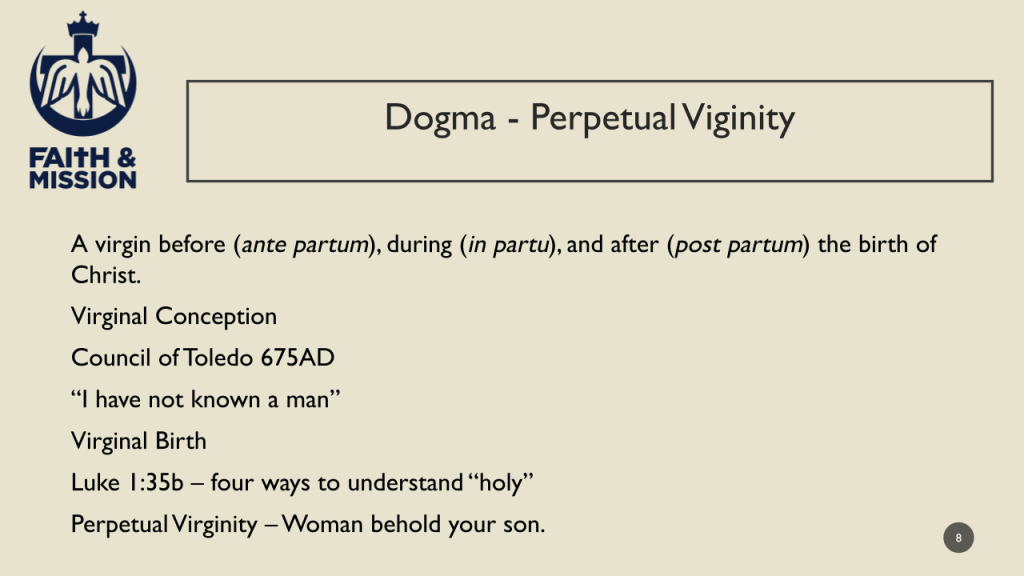
Catholic teachers like St. Pope John Paul II taught that the infancy narrative in the gospel of St. Luke must be taken at face value. That means that the angel Gabriel knew what he was meeting when he was “sent from God to a town of Galilee called Nazareth, to a virgin betrothed to a man named Joseph, of the house of David, and the virgin’s name was Mary.” (Lk 1:26-27) Furthermore, the testimony of the angel on how she would come to conceive Jesus was stated clearly: “And the angel said to her in reply, “The holy Spirit will come upon you, and the power of the Most High will overshadow you. Therefore the child to be born will be called holy, the Son of God.” (Lk 1:35)
These facts mean that the persistent efforts of famous Lutheran theologians in the 1800s to demythologize the gospel must be dismissed. One cannot accept both the plain text of the gospel and also the idea that somehow Mary conceived in reproduction of an egg without male fertilization, or that the story is simply development of an older Jewish theme or a pagan legend.
In 675, the Council of Toledo said that the virginal conception is “neither proved by reason nor demonstrated from precedent. Were it proved by reason, it would not be miraculous; were it demonstrated from precedent, it would not be unique.”
Mary asks the angel how this can be since she has no relations with a man. Bible scholars like St. John Paul II point out that this shows us two things. First, whatever is happening to Mary is completely unlike all the other Biblical cases of a sterile woman suddenly becoming pregnant. All those women had normal relations with their husbands but nothing came of it until God provided fecundity through natural human actions. Here, Mary is clearly on a path of not participating in those natural human actions and yet she will conceive in her womb the Son of God. This is a sign of her intentional virginity and her determination to remain a virgin even when married to Joseph. A vow to be married yet remain a virgin is profoundly contradictory to modern ears, and modern readers struggle to accept that this plan could have been accepted by Joseph. But that is what the Church has consistently taught on the matter.
Virginal Birth
According to the Church Fathers, Mary gave birth to Jesus “without corruption,” which means Jesus left her womb without opening it, without inflicting any injury to her bodily virginity, and therefore without causing her any pain. Indeed, as Lumen Gentium #57 (SCV) says, “Our Lord, who[se birth] did not diminish His mother’s virginal integrity but sanctified it.” John Paul notes that the Church Fathers set up a significant parallel between the begetting of Christ ex intacta Virgine [from the untouched Virgin] and his Resurrection ex intacto sepulcro [from the intact sepulcher]. Matthew says the angel rolled back the stone. The others note the stone had been rolled away. In all cases, by God’s power a natural course has been overwhelmed and a miraculous outcome has occurred without breaking that natural course. Only one time did God become Man by a Virginal Birth and only one time did Man resurrect from the dead by his own power. In both occasions, that Man was God, and the Incarnation of God is a central Christian dogma. Mary’s Perpetual Virginity is in perfect accord with the Incarnation and the Resurrection.
Mary is the New Eve, but she is greater than Eve. From the Catechism of the Council of Trent, we read a teaching on Genesis 3:16:
To Eve it was said: “In pain you shall bring forth children” (Gen 3:16). Mary was exempt from this law, for preserving her virginal integrity inviolate, she brought forth Jesus the Son of God, without experiencing any sense of pain.”
Four ways to understand “holy”
Since the time of the Fathers until the present, there have been four ways to understand and translate the “holy” used in the words of the Archangel Gabriel:
τὸ γεννώμενον ἅγιον κληθήσεται Υἱὸς Θεοῦ
“the” “one to be born” “holy” “will be called” “Son” “of God”
- Holy is the subject: “that is why the holy (child) who is to be born will be called Son of God”
- Holy is related to “will be”: “And so the child will be holy and will be called Son of God”
- Holy relates to “called”: “This is why the one to beorn will be called holy, Son of God.”
- Holy relates to “be born”: “This is why the one who will be born holy will be called Son of God.”
The last approach was favored by Medieval thinkers and it informs the birth and highlights the perpetual virginity of Mary before, during, and after that birth. Mary is Immaculately conceived (without blemish) and her birth of Jesus is likewise without blemish.
Lifelong Virginity
In the words of Jesus from the Cross, the Church sees confirmation of Mary’s perpetual virginity. Never having known a man before the birth of Jesus, never did she know one after that Virgin birth. Having no other children, Jesus makes sure she is entrusted to the disciple John’s care before he gives up his life for our salvation.
St. Ambrose taught that the “closed gate” of Ezekiel, and the “enclosed garden” and “sealed fountain” of the Song of Songs were Old Testament symbols of Mary’s perpetual virginity.

 Bound in Love
Leave a comment