Mediation is used in a variety of senses to cover the basic dimensions of the economy of salvation (how God’s plan is worked out in creation). They are all interrelated. Mediation simply means that God will use beings to effect his plan; he does not always speak directly but frequently he speaks through people. Think of the job of a prophet: he is to say what God wants said at the time God wants it said and to whom God wants it said. For some reason, God chooses these intermediaries instead of direct voice or action.
Why mediators?
We don’t want to face God directly.
- Moses coming down from Mt. Sinai; the people are frightened.
- Jesus on Mt. Tabor at the Transfiguration; the Apostles are frightened.
Jesus comes as a human (Phil 2 6-11) to show us how much the Father loves us. We dared not believe until we saw it in a form we could comprehend and accept.
Mary is special
The predestination of Christ as incarnate Son of God, to be Head and Savior of his body, the Church and of all his members, constitutes what is known as “the order of the hypostatic union.” (Christ is truly God and truly Man.)
To that order in a special way belongs one of the saved: the Immaculate Virgin, Mother of the Savior-Word incarnate. She is the pre-eminent member of the Church, its Mother. No other creature has the same relation to the Son of God. From this unique position in the order of the hypostatic union we can see the joint predestination of the Son and his Mother in one and the same decree. By the merits of Christ she is incomparably holy. Therefore, in a way unique to her, she can cooperate actively with Jesus as our co-redemptrix. Mary’s mediation is the divinely appointed means by which the whole of creation and in particular the human family is recapitulated in Christ the Head, and so she enjoys the blessing willed by the Father and gained for us by Christ.
St. Maximilian Kolbe: the mediation of Mary crystallized in her fiat is the high point where all the love of the Blessed Trinity appropriated to the Holy Spirit meets all the love of creation, a juncture which brings to pass the Incarnation and economy of salvation.
Of all graces to all creatures
Mary is the mediatrix of all creatures, angels and men, because God in Christ has assigned this function to her in order to reunite all creatures to Christ. The saved are members of Christ’s body in being born spiritually of the Woman, just as all men naturally have Adam as their head and the origin of their humanity through a woman and not otherwise. In herself Mary, without sin, possesses the human nature of Adam that unites her to sinful humanity, the spirit that unites her to the angels, and the fullness of grace that brings her into union with the God-man and so brings him into union with the sons of Adam. Through Mary, Christ descends from Adam and Abraham. Thus, through Mary he is our Savior and Mediator. We go to him the same way: to him through Mary. Her mediation reconstructs the unity between God and man that was broken in the fall and remains wounded. The merit of Christ is absolute, while the merit of Mary is relative because it originates in Christ and is exercised in conjunction with his.
Advocate and Queen
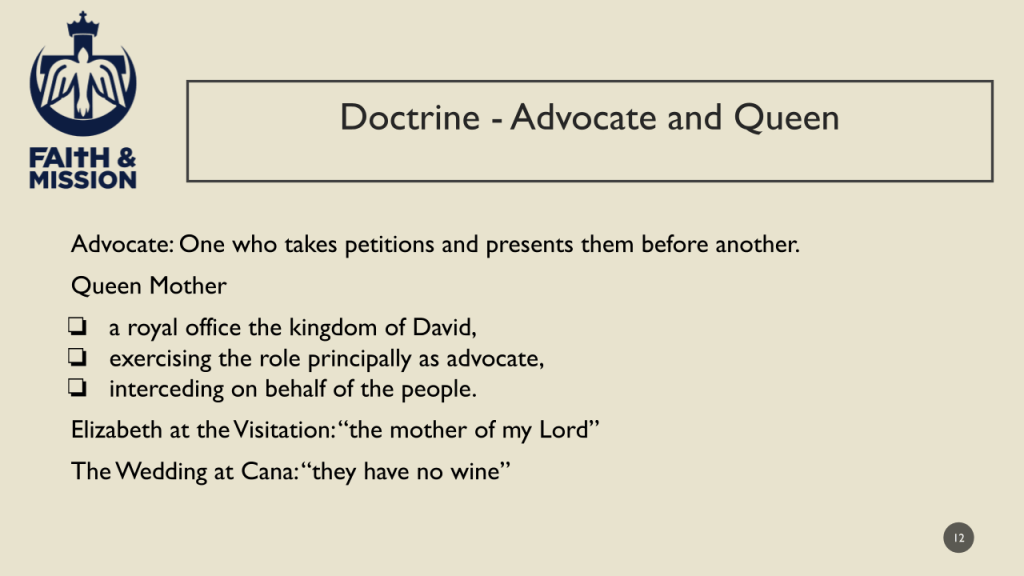
Prayers asking for her help are found as early as the middle of the third century (c. 250AD)
“We fly to thy protection, O holy Mother of God, despise not our petitions in our necessities, but deliver us from all danger, O ever glorious and blessed Virgin.”
The Queen Mother was a job, an official position in the kingdom of David. She was to stand near the throne and be an advocate for the petitions of the people. She was an official conduit to the king for petitions for mercy and assistance. She was uniquely important: while the king might have many wives, he had only one mother.
When we read the historical books in the Bible about the kings of Judah and Israel, they name the king’s mother but not his wives. This is a textual indication of her official importance.
She had a crown (Jer 13:18). She had a throne (1 Kgs 2:19). She was there when big things happened: the emigration of the royal court to Babylon under Jehoiachin (2 Kgs 24). Prophets prophesied to both king (ϰ𝜐ρɩο𝜍) queen mother (Jer 13:18). Bathsheba is a good one to see the transformation from king David’s wife (has to bow before the king when she enters) to king Solomon’s mother (he rises and bows to her when she enters). Her throne is at his right hand. She gives counsel (Prov 31).
Isaiah 7 includes the prophecy of a virgin giving birth to a son (Immanuel) to guarantee the line of David. And Luke 1 points out that Mary is “of the house of David” (1:26), which sets up Jesus to be the Son of David. The angel tells Mary the child will be given “the throne of his father David” while also be called “Son of the Most High” so we see that he is of the house of David while also being the unbegotten Son of God. Mary is Mother of God and Queen Mother.
Elizabeth recognizes Mary’s Queenship when she greets her with the title “the mother of my Lord” (Lk 1:43), which is the first time Jesus is identified as “Lord” in Luke’s writings. The greek word (ϰ𝜐ρɩο𝜍) is both Lord without saying “Yaweh” and a word to describe the Davidic king.
The Wedding at Cana shows the Mother advocating for the people. She sees that the wedding host has no wine and takes that to her son as intercessor. This scene also shows Mary’s effectiveness as advocate: after saying his hour has not yet come, Jesus provides an answer to the prayer for help.

 Bound in Love
Leave a comment