What do we mean by this term? It is the “particular and unique cooperation of Mary, as Mother of God the Savior, with the redemptive work of her Son, in restoring supernatural life to immortal souls.”
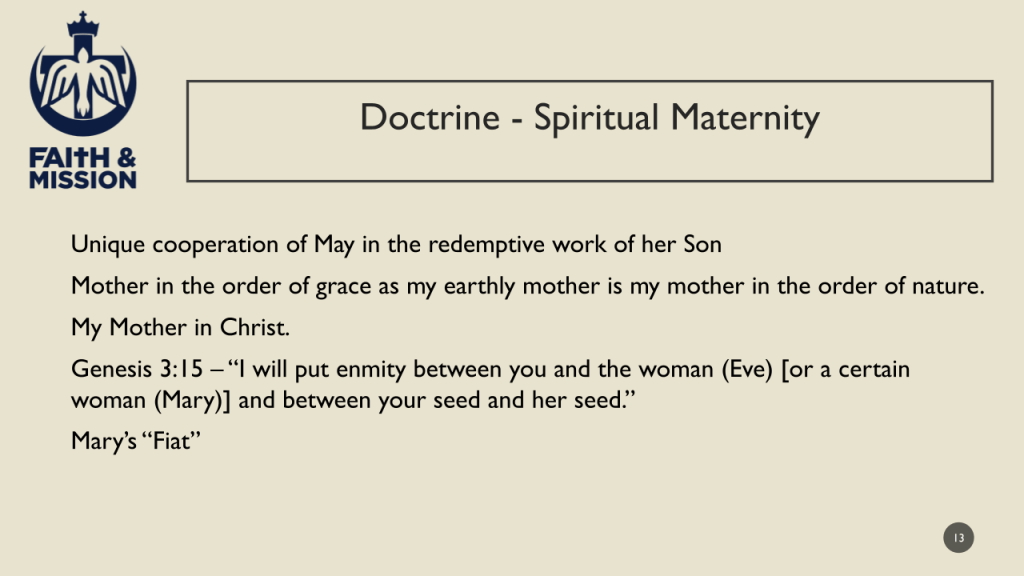
The spiritual motherhood of Mary means that the ever-Virgin is my Mother in the spiritual order (the “order of grace”) in a similar fashion to the way in which the woman who conceived and bore me is my Mother in the natural order (the “order of nature”).
Mary has given us supernatural life just as truly as our mothers have given us natural life.
Supernatural motherhood means a supernatural activity, received and subordinate, in the work of eternal salvation of another human being, by which a created person receives and transmits to another person the divine life. The human being who is elevated to the level of spiritual motherhood receives from God the Father the possibility of engendering supernaturally those who are his brothers and sisters in the natural order. Just as we often talk about our brother or sister in Christ, which captures the reality that we have a supernatural connection beyond the natural connection, we have a unique Mother in Christ.
Eve of Genesis’ third chapter is both the woman just referenced and also “a certain” woman, for the Hebrew article (ha) can have both meanings. The speaker of the verse is clearly God, and it continues with the promise to Satan that “He shall bruise your head and you shall bruise his heel.” This is a prophecy of the ultimate victory won by Jesus Christ. Mary, his Mother, is the “certain woman” of which the Father speaks in the Garden of Eden at the moment of the Fall. By her share in the work of redemption, Mary can properly be called our spiritual Mother.
At the Annunciation, when the angel Gabriel tells Mary of the divine plan for salvation, she accepts the role when she says, “fiat” or “may it be done”. She chooses with her free will, unburdened by concupiscence, to cooperate with God’s plan. Her fiat entails cooperation with the totality of God’s plan: the spiritual rebirth of all of us. From the Cross, Jesus confirms her role when he hands her to John with the words, “Behold your Mother.” John is the only Apostle still there at the foot of the Cross, but he stands for all the Apostles and all disciples of Christ. He stands, therefore, for the Church.
Testimony from the Fathers and Saints
St. Irenaeus: “It was because of a disobedient virgin that mankind was stricken, fell, and died. Likewise, it is by the Virgin obedient to the Word of God that man, reanimated by Life, has again recovered life.”
St. Gregory the Wonderworker: “From on high came the divine Word, and in Mary’s holy womb reformed Adam.”
St. Augustine of Hippo: “According to the spirit Mary is not only mother of our Head, the Savior Jesus, but she is mother of his members, which we are.”
St. Anselm of Canterbury: “God created all things, and Mary gave birth to God. God, who made all things, made himself from Mary; and so, all things which he had made, he remade. He who was able to make all things from nothing was not willing to remake them, when they were violated, without Mary. God then is the father of created things, and Mary the mother of recreated things.”
St. Maximillian Mary Kolbe: “The Immaculata has left this earth; but her life has only grown deeper and richer; it grows and flourishes more and more in the lives of Christians.”
Mother and Model of the Church
These titles are related because of the essential characteristic of a mother. A mother has given her children their very being and her example should exert a profound influence on everything which pertains to their perfection. A mother bears her children and she raises them. We are the Church, those called to be children of God. She is the Mother of God, and she is the Mother of God’s children – the Church. As Mother of the children of God, she is role model and example, teacher and guide, and every other function a mother takes on as part of rearing her children.
Mary Mother of the Church
The title, Mother of the Church, was solemnly proclaimed by Pope Paul VI November 21, 1964 (Feast of the Presentation of Mary) during the Second Vatican Council. But the title is ancient, acknowledged by the Church since the Middle Ages. The Council Fathers, perhaps out of fear of upsetting Protestants, declined to include this title in the council’s documents, so the doctrine has been discussed by theologians a lot since the mid-1960s.
Mary’s presence at the foot of the Cross, and Jesus’ giving her to John is seen as Scriptural proof of her motherhood of the Church. It captivates theologians that in his last moments alive on Earth, Jesus spoke to Mary, saying “‘Woman, behold your son!’ Then he said to the disciple, ‘Behold, your mother!’ And from that hour the disciple took her to his own home.” (Jn 19:27) Most of the Seven Last Words from the Cross seem to be a proof of the New Covenant and establishment of the Mass as a memorial of that Sacrifice. This Word, however, establishes the Church to remain until He comes in judgment and glory at the end of time.
Mary Model of the Church
What is a model? A model like a model train is a copy of something. A model is more generally a schematic or a template for others to follow or copy. A model transmits being and life to its copy analogically. Outside of digital copies, the model and the copy are not exactly identical. The model and the copy are unique, yet they are profoundly similar.
As a model, as something or someone to copy, Mary is properly due special veneration. This traditional custom is rooted in the Gospel story of the Visitation, where Elizabeth, the mother of John the Baptist, describes Mary as “blessed is she that believed.” Mary believed without doubt, and her unsullied faith in God’s plan of salvation is a model for our own wounded faith. Her example is helpful for us, and we honor her in a special way because she is what we hope to be.
Mary is also a model for the institutional Church. She trusted in the Holy Spirit, mediated by the Archangel Gabriel. The Church should also trust the Holy Spirit that was given as its sure protection by Jesus, but the bishops through the centuries have not been as faithful as Mary.
Mary is a model for the whole Church. For the Church Militant, she is a peerless example of human trust in the eternal Father despite difficulties and deep sorrows. Those of us who have lost a child can look to Mary for both comfort and a model of how to act. Those of us who have wondered what God really wants for us can look to Mary as a model for how to listen and look for God in our daily lives. She is a model of prayerful contemplation.
Mary is a model for the Church Suffering. The souls in Purgatory as they are cleansed of the residue of their sinful lives can contemplate the Seven Sorrows of Mary and be encouraged to persevere with joy amid the pain of purgation.
Mary is a model of the Church Triumphant. The saints in Heaven enjoy the real presence of the Lamb on his throne, and they can behold the Queen Mother standing in her glorified body and foresee the return of their bodies at the Second Coming.

 Bound in Love
Leave a comment