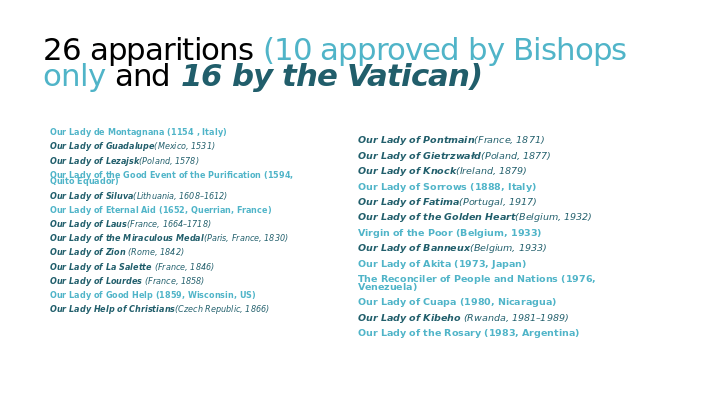
Here is the list of the approved apparitions
Our Lady of the Good Event of the Purification
Our Lady of the Good Event of the Purification is a Catholic Marian title referring to the Purification of the Blessed Virgin Mary and the Presentation of Jesus in the Temple, celebrated on February 2 (Candlemas). The title originates from a series of alleged apparitions to Mother Mariana de Jesús Torres, a Conceptionist nun in Quito, Ecuador, between 1594 and 1634.
The name “Good Event” (Spanish: Buen Suceso) literally means “Good Event”, not “Good Success,” which is a common mistranslation. The official title is Nuestra Señora del Buen Suceso de la Purificación.
The apparitions, approved in 1611 by Bishop Salvador Ribera Avalos, included prophetic messages about a spiritual crisis in the Church and society beginning in the 20th century, including moral corruption, loss of priestly and religious vocations, the decline of chastity, and the influence of Freemasonry.
A miraculous statue of Our Lady, completed in 1611, was said to have been animated by the Virgin Mary singing the Magnificat. It was solemnly crowned in 1991.
On February 2, 1634, the 40th anniversary of the first apparition, the sanctuary lamp extinguished during prayer, symbolizing the future darkness of faith. Our Lady explained five reasons for this, including heresy, loss of virtue, and the corruption of the clergy.
The devotion is centered on penance, prayer, and sacrifice as a means of spiritual restoration. A Novena is traditionally prayed from January 24 to February 2.
The Governing Council of the Conceptionist Monastery in Quito has officially requested that the title be used in full: Our Lady of the Good Event of the Purification, emphasizing its connection to the Purification and Presentation of Jesus.
Our Lady of Eternal Aid
On August 15, 1652, the deaf and mute shepherdess, Jeanne Courtel, then aged 12, was tending her father’s flock when Our Lady appeared to her. Jeanne was healed of her afflictions immediately. Our Lady asked Jeanne to have a chapel built for her veneration. The conversation continued and she asked Jeanne for one of her lambs, to which Jeanne replied, “These sheep are not mine, they are my father’s.” Our Lady offered to care for the sheep while Jeanne left to obtain permission from her father to give Our Lady one of his sheep.
In the days that followed, Our Lady appeared several more times always asking that a chapel be built. She even also said: “To prove that the message that comes from heaven’s command, I tell you that you will discover a few steps from the fountain of Saint-Gal … an image that was honored in ancient times.” A thousand years earlier in 610, St. Gall came to the area and built a hermitage. He also sculpted a statue of the Blessed Virgin Mary. On August 20, 1652, the statue was located in the pond and found in excellent condition even though it had been submerged for centuries.
A month later, the local bishop visited the area to make his investigation. He formally recognized the validity of the apparitions and blessed the first stone laid as the foundation for the chapel. It was completed four years later. Jeanne Cortel died at the age of 63 in 1703 and was entombed in the shrine at the apparition site. In 1779, the chapel was enlarged due to the growing crowds of pilgrims that came to visit. In 1950, over 20,000 pilgrims attended a coronation of the statue at the site
Our Lady of Laus
This refers to a series of Marian apparitions reported to have occurred between 1664 and 1718 in Saint-Étienne-le-Laus, France, to Benoîte Rencurel, a young shepherdess from a poor family. The apparitions, which spanned 54 years, are recognized as the longest recorded Marian apparition in history. The Virgin Mary appeared to Benoîte over 2,500 times, delivering a message centered on repentance, conversion of sinners, the importance of the sacraments, and devotion to the Eucharist.
The site, known as the Sanctuary of Our Lady of Laus or “Refuge of Sinners”, was established following the Virgin’s instruction to build a chapel dedicated to her Son. A miraculous healing of a crippled woman, witnessed by Father Antoine Lambert, led to official Church approval for the construction of the sanctuary. The apparitions were formally approved by the Holy See on May 5, 2008, by Bishop Jean-Michel de Falco of Gap, marking them as the first Marian apparitions officially recognized by the Church in the 21st century.
The Laus Manuscripts, a collection of over 1,800 pages of testimonies from eyewitnesses, including priests and judges, provide extensive historical documentation. Today, the sanctuary remains a major pilgrimage site in southern France, drawing thousands seeking spiritual renewal and healing.

 Bound in Love
Leave a comment