Contributing to the idea that everything is changing in this age, and therefore change may be the defining characteristic of this age, is the rapid pace of technological innovation and revolution. We spent about 100 years moving from horse-drawn vehicles that moved at about three or 4 miles an hour to automobiles — that is vehicles that have internal propulsion systems and do not require a horse — that routinely operate at 80 miles an hour, and we have airplanes that can get us from city to city at speeds over 500 miles an hour. This means that we just move faster than we used to.
Alongside and after the mobility revolution we’ve had the information revolution. The change from the monks to the printing press was dramatic, but paper was the medium through which we communicated most information all the way up until the invention of the radio and shortly after that the television. Suddenly, one person could broadcast his remarks rather than send them to a printer and distribute books or pamphlets. The next thing technology did was shrink and consolidate. So today we carry in our pockets a computer with more power to process instructions and more storage to save information than the mainframes of the 1950s and 60s.
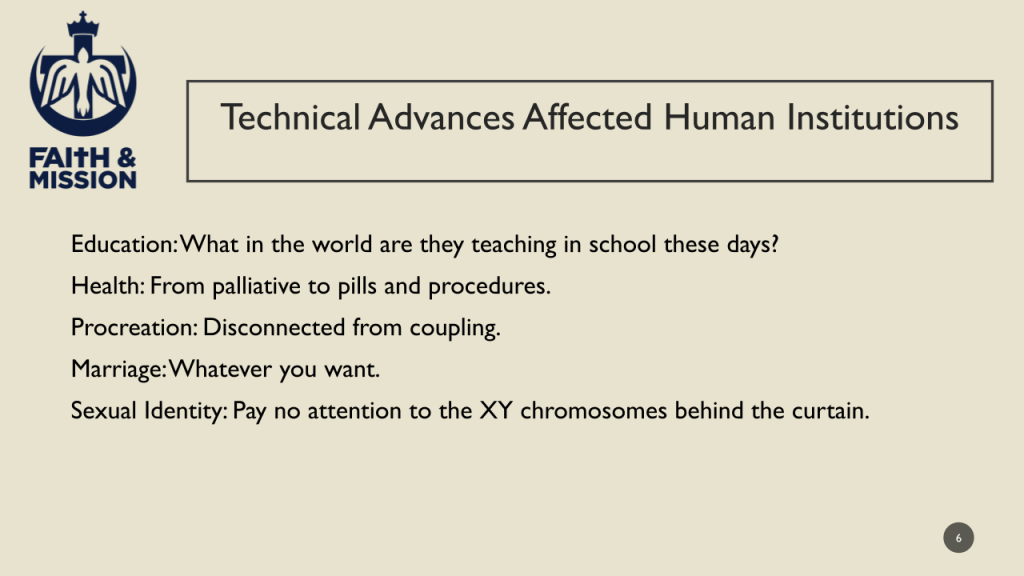
The pace of change over the last hundred to 150 years has been so rapid that institutions aligned to the eternal mindset of God seem to be pretty far behind the curve. The Catholic Church was established by Jesus Christ and is protected by the Holy Spirit. God — who is eternal — set up the church and guards the church. Changes from age to age don’t touch him, but they have touched his church.
The author concludes:
This extraordinary development in the applied sciences, especially in the area of electronic technology, has brought in its train an unprecedented explosion of images and information assailing each individual mind, even the youngest child’s, laced with assumptions about how to be successful and what it means to live a good life. The person living in the modern world is incessantly hounded and cajoled by Gospels of various kinds, schemes of salvation and routes to happiness wrapped in highly attractive but often deceptive clothing.
A central aspect of the major changes in our culture that we recognize over the past 150 years is the development of an intellectual argument and structure to support a new definition or new behavior that is deeply contrary to the old argument or old structure. Some of our terminology has been changed by activists because the old terms carried so much moralistic baggage that new terms were needed that sounded scientific and neutral. Thus the term sodomy has been replaced by homosexual and heterosexual. And the idea of human rights has been used to justify the murder of innocent unborn children.
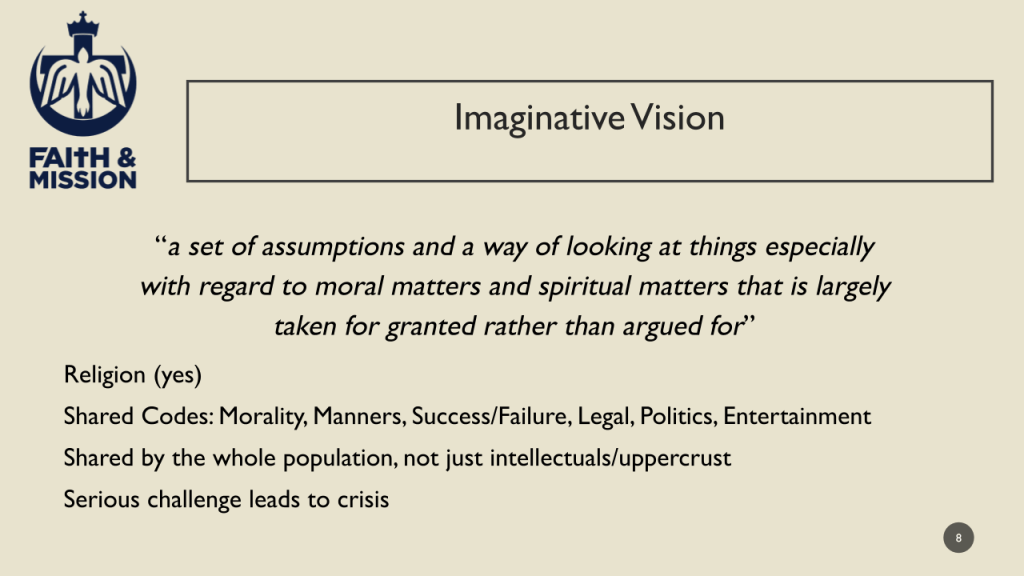
The author introduces a term “imaginative vision” that he says is a set of assumptions and a way of looking at things especially with regard to moral matters and spiritual matters that is largely taken for granted rather than argued for. As a holistic way of seeing things, it is usually secured by a religion that speaks to the deepest questions we ask.
But it is more than just our religion because it is not only a moral code but also a shared vision of what is a good person, shared understandings of what we mean by success and failure, shared economic and political values, a shared legal structure and a public policy structure, and even shared sense of what good manners are and what entertainment should be.
This vision is not just for specially educated people but it’s the vision that is shared by the whole society. So even if you cannot really defend it, you will possess it. When civilizations are strong this vision is settled and the longer it is settled the more deeply and unconsciously it is assumed. If the vision is seriously challenged then the society will go into a crisis until either the original vision is confirmed or a new vision replaces it.

 Bound in Love
Leave a comment