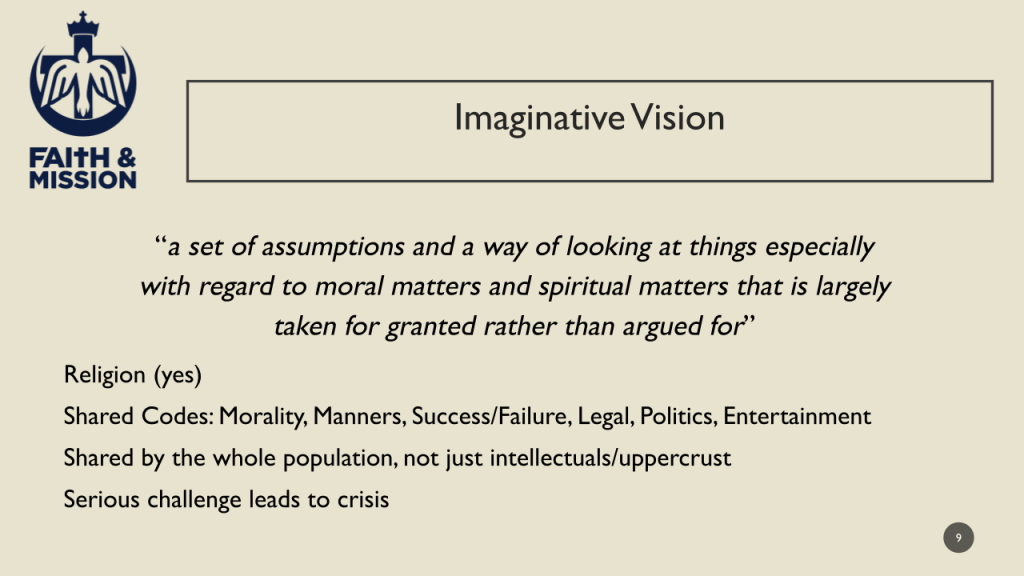
The author introduces a term “imaginative vision” that he says is a set of assumptions and a way of looking at things especially with regard to moral matters and spiritual matters that is largely taken for granted rather than argued for. As a holistic way of seeing things, it is usually secured by a religion that speaks to the deepest questions we ask.
But it is more than just our religion because it is not only a moral code but also a shared vision of what is a good person, shared understandings of what we mean by success and failure, shared economic and political values, a shared legal structure and a public policy structure, and even shared sense of what good manners are and what entertainment should be.
This vision is not just for specially educated people but it’s the vision that is shared by the whole society. So even if you cannot really defend it, you will possess it. When civilizations are strong this vision is settled and the longer it is settled the more deeply and unconsciously it is assumed. If the vision is seriously challenged then the society will go into a crisis until either the original vision is confirmed or a new vision replaces it.

The author uses the word “imaginative” less to mean made up than to remind us that we hold things in our heads as true even if there’s no confirming data and sensory data in our immediate circumstances. For example, we can know what a good man is even if we are surrounded by thieves and murderers. If we are all by ourselves in the desert, we can carry in ourselves that whole vision of what society looks like and should be, and therefore it is something we can imagine even if we don’t experience it directly.
The author uses the American system of government as an example. We are so experienced with and hold as the ideal governmental system called democracy, that we can hardly imagine what a monarchy might look like. We certainly wouldn’t take it very seriously.
This shared vision leads to a shared narrative. The story of our society and culture is something that we carry with us, and it can guide us, when we are completely alone. One of the beneficial functions of traditions and cultural practices is that you can just kind of do it; you don’t have to completely understand it or be able completely to defend it philosophically or intellectually. Most of us don’t have time to do that because we have to live the day that we’ve just been given.

 Bound in Love
Leave a comment