We will spend some time on the principal teachings about Mary, some of which are required for authentic membership in the Church of Christ, and some of which are teachings that may help us grow as disciples of Christ.
Then we will spend some time on Marian devotions and Marian apparitions.
Marian Doctrines are Christological Doctrines
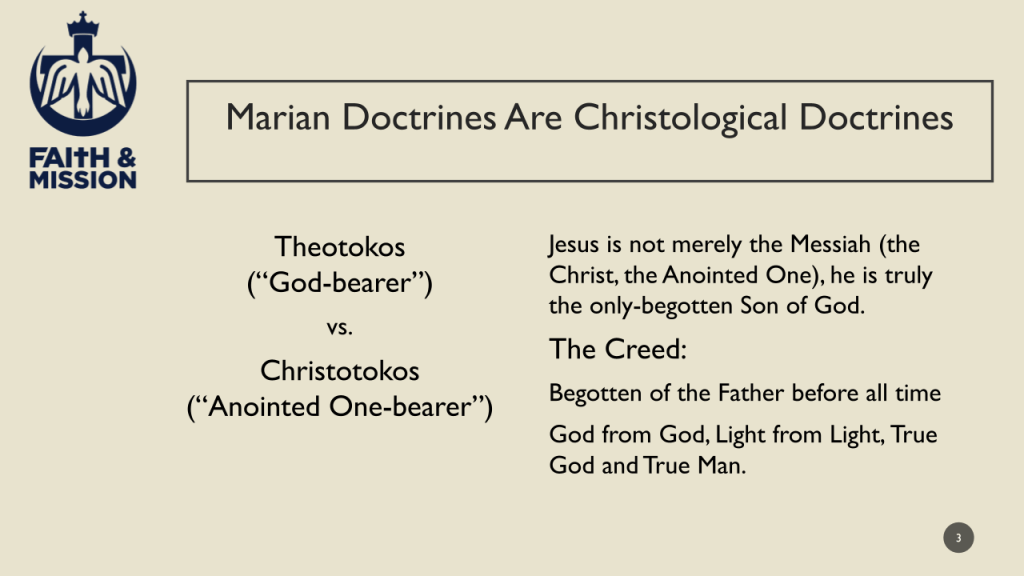
Anything we say about Mary is because we are saying something about Christ and his Church. Protestants who argue that we adore Mary or show her undue veneration are simply missing the point. When one considers Mary, one must out of necessity consider her Son, for there is no Mary without Jesus and his Church. She is not one among many Saints. She is not one among many disciples. She is the saint par excellence, the disciple without peer. She is these things because of her Son.
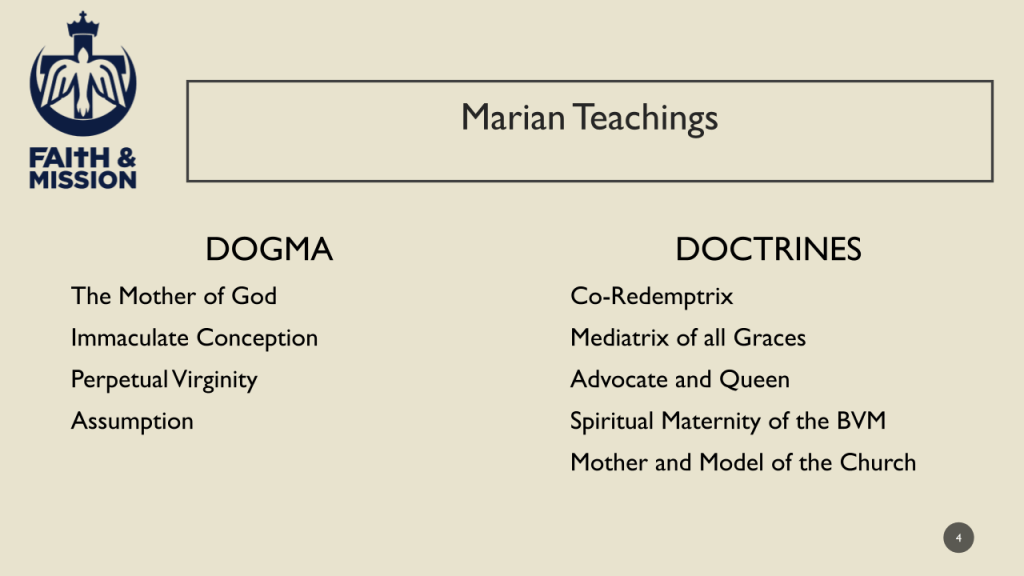
Marian Teachings
The teachings about Mary can be separated into dogmas and doctrines. The difference between a dogma and a doctrine has to do with the limits of our natural intellects and the requirement of belief. A dogma is more narrowly defined as that part of doctrine which has been divinely revealed and which the Church has formally defined and declared to be believed as revealed. That can be said another way: some truths that must be held are simply too big for our brains. In the Old Testament, the burning bush that Moses encountered is a good example of something that is true yet is beyond logic or our intellectual capacity. We hold it as true because God revealed it to us. In the Holy Mass, we encounter the dogma of the Real Presence: that which continues to look and taste like bread and wine is no longer bread and wine but the Body and Blood of Jesus Christ. He is really present, if not physically/bodily present. He is really present in the sacrament of the confected Eucharist, the consecrated bread.
Other teachings are the result of our intellects being applied to the mysteries of the faith. These are helpful theological speculations and arguments. One should use them as they are helpful for your own spiritual growth. So, one should struggle with them rather than reject them out of hand. Through time, there may be great spiritual fruit borne from this religious consideration of these teachings.
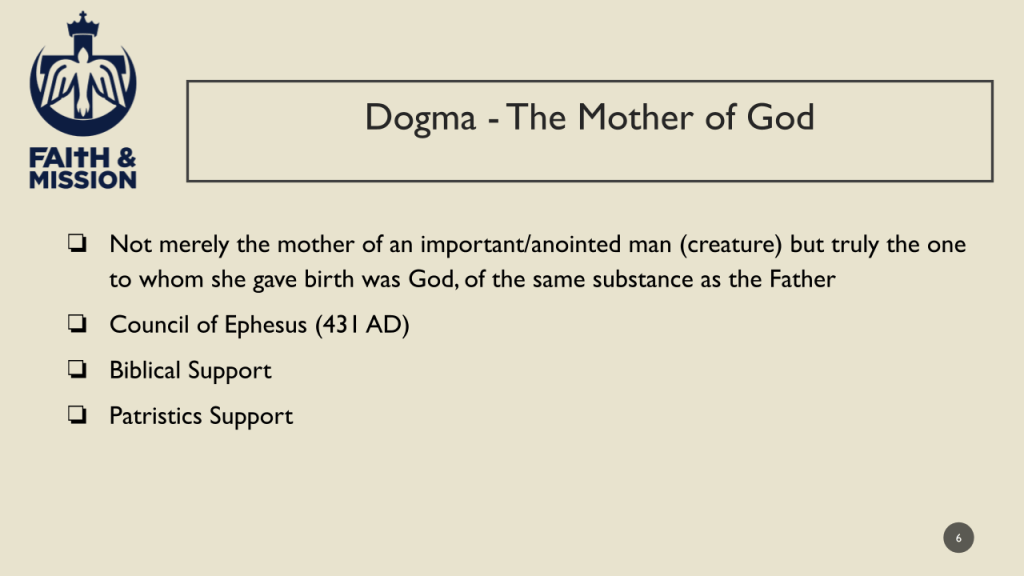
Dogma – The Mother of God
The title in English “mother of God” applies to Mary and is a matter of revealed truth and required belief. Catholics believe that God truly sent his son into the world through the Blessed Virgin Mary. So when we say the phrase “mother of God”, the emphasis that the church places on the word God is at least as important as the word mother. At the Council of Ephesus in 431 A.D., the church stated definitively that Mary was the Theotokos, which is to say she was the bearer of God. The argument had been made that Mary gave birth to the Christ but not to God.
If you think about that for just a moment, you can see how the Marian teaching is derived from the teaching about Christ. The church denied the idea that somehow Christ was a creature. It insisted that Christ was of the same substance as God the father. It also insisted that he had in that one person of the Trinity both the nature of God and human nature. The church word that you see that encapsulates this idea is hypostasis.
The claim that Christ is both human and divine is essentially the claim that got him crucified. It is a radical claim. It is not laid out clearly in the Old Testament that Jesus the Messiah will be both human and divine, so the Jews of the time of Jesus had no scriptural basis to accept this as a plausible teaching. If you have seen the movie “The Passion of the Christ”, think of that scene when the high priests are before Herod and Pilate and their outrage at the blasphemy of a man claiming to be the son of God. The claim was so outrageous, that the young zealot named Saul approved of the stoning of the Christian martyr Stephen when he preached what the church teaches. Saul, who later became Paul after his experience of conversion on the road to Damascus, thought he was doing the Lord’s work when he was trying to stamp out this weird sect that eventually was called Christians.
In the gospel we do see a couple of instances where Jesus says directly or almost directly that he is God. He uses the phrasing that is reserved for God the father of the Old Testament. His intimate disciples see him at the Transfiguration in all his glory and hear a voice from heaven say this is my beloved son. At the baptism of Jesus, a similar statement from heaven and the descent of the Holy Spirit in the form of a dove. And on Good Friday, a day on which Jesus the man clearly died on the cross with witnesses, according to the gospel of St. Mark the centurion said truly this was the son of God. So it has been the case from the very beginning that the good news was that God became man — that’s Jesus — and then offered himself so that through his death and his resurrection the kingdom of heaven could be open to all who would believe.
So this teaching about Christ has a natural and obligatory consequence for our understanding of Mary. Because of Jesus, she’s not just a woman, she is the woman by whom or through whom God became man. It is clear from the dialogue in the gospel between the Archangel Gabriel and Mary that Joseph was not the biological father of Jesus. When Mary asked how this would happen she was told that the Holy Spirit would overshadow her. But the consequence of that overshadowing is that Jesus is truly God. Even as he is truly man, he is truly God. And this means that Mary is the mother of God; she is not merely the mother of a great man. Jesus was God from the moment of his earthly conception as man. Always divine because of his being co-eternal with the Father, somehow that divinity coexisted without conflict in the humanity of the human person born in a manger in Bethlehem and killed on the cross at Calvary.
Obviously Mary does not generate God in his divinity, but she generates the son of God in his humanity, because he takes his human nature from her. The church sees from this cooperation with the will of God that Mary’s dignity is above that of the whole of creation.
Biblical References Supporting the Birth of God through Mary
Galatians 4:4-5 – “God sent his Son, born of a woman, born under the Law, to redeem those who were under the law, that we might receive the adoption of sons.”
Luke 1:35b – “Therefore, he who is to be born of you shall be holy and shall be called the Son of God.”
Philippians 2:5-8 – “Christ Jesus, who, though he was in the form of God, did not count equality with God a thing to be grasped, but emptied himself, taking the form of a servant, being born in the likeness of men. And being found in human form he humbled himself and became obedient unto death, even death on a cross.”
Luke 1:43 – “To what do I owe that the mother of my Lord (Kyrie) should come to me?”
Patristics Support
Ignatius of Antioch (2nd Century): “Be deaf whenever one speaks to you apart from Jesus Christ who was of the race of David, of Mary, who was really born, ate and drank, was really persecuted under Pontius Pilate.” (against Docetism)
Irenaeus of Lyons (3rd Century) against Docetist/Gnostics who claimed the Son of God came to earth with a heavenly body which only passed through the womb of Mary as water passes through a channel. Jesus “was born through a virgin, but not of a virgin, and in a womb, not of a womb.”


 Bound in Love
Leave a comment