Immaculate Heart of Mary
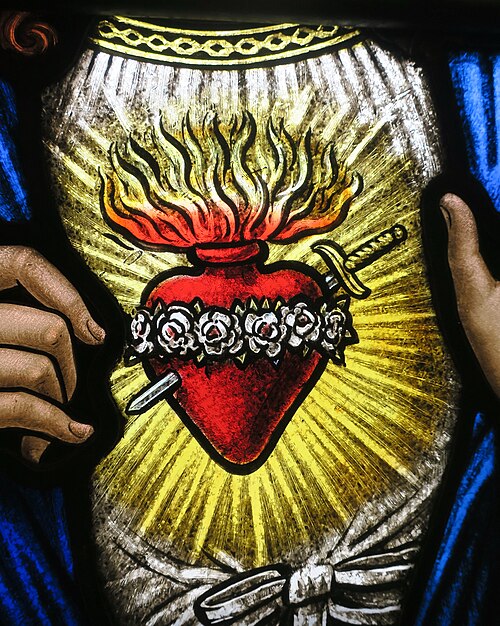
Jesus chose to come to us through the Blessed Virgin Mary, and faithful Christians can choose to go to Jesus through Mary. Our Lady, who is unique in all of God’s creation, has a perfect love for Jesus. She is an exemplary model for how we should love God, giving us a flawless example. Mary is closer to Christ than any other person and knows best what leads us to Him. As at Cana, where she told the servers “do whatever He tells you”, Mary, our Mother, wants to bring souls to God and is eager to help us reach Heaven. Many popes and saints have greatly advocated and praised devotion to the Blessed Virgin – even calling it a sign of ‘predestination’ (click here).
It has been shown that Mary leads faithful Catholics closer to God through devotion to her Immaculate Heart. At Fatima, the Blessed Virgin indicated that the Lord wanted to establish a devotion to her Immaculate Heart, which has been so wounded by the sins of man. She confirmed her requests with fulfilled prophecies, cures, solar phenomena (witnessed by tens of thousands of people), and other miracles. It is clear that this powerful devotion can help us become more holy, grow in love for Christ and Mary, and reach Heaven. As Bl. Jacinta of Fatima said, “Tell everybody that God gives graces through the Immaculate Heart of Mary. Tell them to ask graces from her, and that the Heart of Jesus wishes to be venerated together with the Immaculate Heart of Mary. Ask them to plead for peace from the Immaculate Heart of Mary, for the Lord has confided the peace of the world to her.” And even more important than achieving peace on earth, the Immaculate Heart of Mary can help us obtain eternal peace, in heaven with herself and with her divine Son, Jesus Christ.
Catholics devoted to the Immaculate Heart of Mary should follow Our Lady of Fatima’s “Peace Plan” (click here), including wearing the Scapular, praying the Rosary daily, and performing the first five Saturdays devotion. Catholics should consecrate themselves to the Immaculate Heart of Mary (click here), which attests to one’s confidence that Mary will help & protect them and that she will lead them directly to Jesus, like a mother who holds her child’s hand and helps them stay on the right path.
We know that Mary, full of grace, is the new “Ark of the Covenant”, who was chosen by God as worthy to bear the Word become Flesh. She is a most trustworthy guide to Christ and those devoted to her Immaculate Heart assuredly have a powerful aid to salvation.
“To be devout to you, O holy Virgin, is an arm of salvation which God gives to those whom He wishes to save” (St. John Damascene, Doctor of the Church)
“If you persevere until death in true devotion to Mary, your salvation is certain.” (St. Alphonsus Liguori, Doctor of the Church)
“While Peter has the keys of heaven, Mary has the key to God’s heart; while Peter binds and looses, Mary also binds with the chains of love and looses with the gift of pardon. While Peter is the guardian and the minister of indulgences, Mary is the generous and wise treasurer of God’s favors. ‘He who desires grace and does not have recourse to Mary, desires to fly without wings.’ (Dante)” (Pope Pius XII)
—————–
The Catholic devotion to the Immaculate Heart of Mary focuses on the interior life of the Blessed Mother, meditating on both her inner joys and sorrows, the virtues she exhibited, and her threefold love for God the Father, her maternal love for her son Jesus, and her compassionate love for all people.
The Immaculate Heart of Mary
The heart of Mary has been attracting Christians from the very beginning of Christianity. There are countless names, titles, and devotions bestowed upon Mary, Mother of God. She has been called Holy Virgin of Virgins, Mother of the Church, Mother of Mercy, Mirror of Justice, Seat of Wisdom, Mystical Rose, Ark of the Covenant, Morning Star, Queen of Angels, Comforter of the Afflicted, Undoer of Knots, Star of the Sea, and Refuge of Sinners.
Mary is known not only for her names and titles, but for the many locations of her apparitions which have bestowed on her the names: Our Lady of Lourdes, Our Lady of Fatima, Our Lady of Knock, and countless other appearances. She also stands at the heart of the Rosary prayed in mediation on the biblical joyful, sorrowful, glorious, and luminous mysteries of her son. She is also recognized in our feast day celebrations of her Immaculate Conception and her Assumption into heaven.
St. John Eudes was one of the early leaders in the devotion to Mary’s Immaculate Heart and was part of her first feast day held in 1648. After this date, religious orders dedicated to the devotion of Mary’s heart began to rise. Then with the revelation of the Miraculous Medal in 1830, even greater attention was drawn to Mary’s heart. In 1855, the office and Mass in honor of The Most Pure Heart of Mary was approved. Pope John VI has said on behalf of this day:
“May the Immaculate Heart of Mary shine before the eyes of all Christians as the model of perfect love toward God and toward our fellow beings.”
The Immaculate Heart of Mary is a specific devotion to Mary’s heart, and thus her full and total self-surrender and love for her son, for God, and for all of us as her adopted sons and daughters. But with such intense and total love and surrender often comes great suffering, and this is the perspective I take in my own reflection on the power of the Immaculate Heart.
Hearts of Suffering
The Immaculate Heart of Mary is often pictured as being pierced by a sword, just as the Sacred Heart of Jesus is often pictured as being surrounded by a crown of thorns.
In harkening back to the early life of Mary, we are told in Luke 2 that shortly after Jesus’ birth, he is taken by his parents to the temple in Jerusalem to be consecrated to the Lord as was Jewish custom. Inside, they meet an old prophet named Simeon, who by the power of the Holy Spirit, it had been revealed to him that he would not taste death until he had seen the Lord’s Messiah. When Mary approaches him with Jesus:
“Simeon blessed them and said to Mary, his mother: ‘This child is destined to cause the falling and rising of many in Israel, and to be a sign that will be spoken against, so that the thoughts of many hearts will be revealed. And a sword will pierce your own heart too.’”
LUKE 2:34-35
Simeon foretells the work and mission of Jesus but adds also the immense spiritual pain and suffering Mary herself will undergo as a result of love for her son and obedience to God’s will. Indeed, nearly Mary’s entire life is an act of self-surrender, love, and suffering for her son and for God.
Sufferings of the Immaculate Heart
She undergoes the shame of a pregnancy that her friends and neighbors thought to be sinful. She rides for days, uncomfortable and fatigued on the back of a donkey before giving birth in the cold of a cave. She is forced to flee to the safety of Egypt to keep Jesus from harm’s way of King Herod. She undergoes the depressing prophesy of Simeon, loses her son when he is still a boy while they are traveling, searching for him with great anxiety for days. She weaves in and out of the crowds, following after Jesus as he is escorted to Calvary. And she is the one kneeling at the foot of the Cross and staring up into the dying, bloodied face of her only son unable to stop his pain and suffering.
She endures all things for her son in his mission to save us. Mary’s life is full of tremendous suffering and yet she stands as a model for us of true devotion, love, sacrifice, and obedience for us to emulate.
Likewise, the Sacred Heart of Jesus is a meditation on suffering, particularly on the physical pain of Christ: the nails in his hands and feet, the wound in his side, and the crown of thorns placed on his head. The devotion to the Sacred Heart, like the devotion to Mary’s Immaculate Heart, focus on an interior image of threefold love, in Jesus’ case: his divine love, the burning love of his human will, and the sensitive love of his interior life.
Cling to Love
In both of these devotions, the heart leads to suffering: for the Sacred Heart this is physical suffering and for the Immaculate Heart, spiritual suffering. How often in our own lives this spiritual suffering of the heart rings true: the broken heart of a failed relationship, the desperate yearning of the heart for a wayward child or the pain of losing a loved one. The spiritual pain one feels in the heart is so overpowering and strong at times it can almost be just as tormenting as any physical pain. And yet, even in the sufferings of the heart, where love and longing are greatest, the devotion to the Immaculate Heart of Mary encourages us to cling all the more tightly to love, not to shy away from it or push it under the rug simply because love is hard.
I am reminded of a quote from St. Teresa of Calcutta:
“Love, to be real, must hurt. It must cost, it must empty us of ourselves.”
This might be contrary to the societal view of love as infused with convenience and satisfaction, but the Immaculate Heart of Mary challenges us to love deeply and fully both God and man even when it is difficult in order that we might experience greater holiness in our hearts and in the lives of those around us.
First Saturdays
The First Saturdays Devotion is a Catholic practice of reparation to the Immaculate Heart of Mary, based on messages from the Virgin Mary during the apparitions at Fatima, Portugal, in 1917, and later in Pontevedra, Spain, in 1925. According to Sister Lucia, Mary requested this devotion to console her Heart, pierced by the sins and blasphemies of humanity.
Key Requirements
To fulfill the devotion, one must perform the following on the first Saturday of five consecutive months:
Confession: A sacramental confession, ideally within 20 days before or after the first Saturday, provided the person is in a state of grace.
Holy Communion: Received in a state of grace, ideally at a Saturday Mass or an anticipatory evening Mass.
Five decades of the Rosary: Recited with intention of reparation.
15-minute meditation: On one or more mysteries of the Rosary, done in addition to the vocal prayer.
All actions must be performed with the specific intention of making reparation to the Immaculate Heart of Mary.
The Great Promise
Our Lady promised:
“I promise to assist at the hour of death, with the graces necessary for salvation, all those who, on the first Saturday of five consecutive months, shall confess, receive Holy Communion, recite five decades of the Rosary, and keep me company for fifteen minutes while meditating on the mysteries of the Rosary, with the intention of making reparation to me.”
This promise is understood as a grace for final perseverance, not a guarantee of heaven, as personal cooperation with grace remains essential.
Why Five Saturdays?
Jesus revealed to Sister Lucia that there are five types of blasphemies against the Immaculate Heart:
Denial of her Immaculate Conception.
Denial of her Perpetual Virginity.
Refusal to recognize her as Mother of God and Mother of all humanity.
Implanting indifference, contempt, or hatred toward Mary in children’s hearts.
Desecrating or ridiculing her sacred images.
The five Saturdays correspond to reparation for these offenses.
Practical Guidance
Confession and Communion can be done within a 20-day window before or after the first Saturday.
The Rosary and meditation can be done at any time during the day.
If a Mass is unavailable, a spiritual communion may be offered as a substitute, provided one is in a state of grace.
The devotion is a powerful spiritual tool for personal conversion, peace, and the salvation of souls.
This devotion is deeply rooted in the Fatima message and is encouraged as a way to honor Mary’s role in salvation history and to respond to her maternal plea for reparation.
Our Lady of Sorrows — the Seven Sorrows Rosary
Our Lady of Sorrows Devotion is a Catholic devotion honoring the seven sorrows of the Virgin Mary, rooted in her suffering as the mother of Jesus. It is traditionally observed during September, the Month of Our Lady of Sorrows, culminating in the feast of Our Lady of Sorrows on September 15th.
The devotion centers on meditating on the following seven sorrows:
The Prophecy of Simeon (Luke 2:34–35)
The Flight into Egypt (Matthew 2:13–15)
The Loss of the Child Jesus in the Temple (Luke 2:43–45)
The Meeting of Jesus and Mary on the Way of the Cross
The Crucifixion of Jesus
The Taking Down of Jesus from the Cross
The Burial of Jesus
Each sorrow is honored with an Our Father, followed by seven Hail Marys, and a prayer reflecting on Mary’s suffering. This practice is often called the Rosary of the Seven Sorrows or Chaplet of the Seven Sorrows.
According to tradition, Mary promised seven graces to those who faithfully pray this devotion daily:
I will grant peace to their families.
They will be enlightened about the divine mysteries.
I will console them in their pains and accompany them in their work.
I will give them as much as they ask for, as long as it does not oppose the will of My divine Son or their sanctification.
I will defend them in spiritual battles and protect them at every instant of their lives.
I will visibly help them at the moment of death — they will see the face of their Mother.
I have obtained from My divine Son that those who propagate this devotion will be taken directly from this earthly life to eternal happiness, with all sins forgiven, and will enjoy eternal consolation with My Son and Me.
While the promises are widely shared in devotional literature, it is important to note that the Catholic Church has not officially approved or verified these specific promises, and they are considered part of popular piety rather than dogma.
This devotion encourages spiritual union with Christ’s Passion through Mary’s suffering, fostering compassion, strength in trials, and a deeper love for Jesus. It is especially recommended during Lent and September, and is often practiced through daily prayers, novenas, and meditative reflection.
Miraculous Medal
The Miraculous Medal Devotion is a Catholic tradition centered on the veneration of the Miraculous Medal, a sacramental believed to be a powerful symbol of the intercession of the Blessed Virgin Mary. It originated from the apparitions of Mary to Saint Catherine Labouré in 1830 at the Rue du Bac in Paris. During these visions, Mary appeared standing on a globe, crushing the head of a serpent, with rays of light streaming from her hands—symbolizing the graces she bestows on those who ask. The medal’s front bears the inscription: “O Mary, conceived without sin, pray for us who have recourse to thee.”
The devotion includes the Miraculous Medal Novena, a nine-day prayer practice that deepens one’s relationship with Mary and seeks her intercession. This novena, traditionally prayed from November 18 to November 27 (the anniversary of the first apparition), includes prayers such as the Memorare, the Act of Consecration, and a personal petition for graces. The novena emphasizes purity of heart, repentance, and trust in Mary’s maternal care.
Wearing the medal is encouraged as a sign of devotion and protection. It is recommended to wear it around the neck and to keep it close as a constant reminder of Mary’s presence and intercession. The devotion has been promoted by several Popes, including Pope Pius IX, Pope Pius XII, and Pope John XXIII, who recognized its spiritual significance and the authenticity of the apparitions. The Perpetual Novena at the Basilica Shrine of Our Lady of the Miraculous Medal in Philadelphia has been prayed every Monday since 1930, uniting thousands in prayer worldwide. This enduring tradition highlights the power of Mary’s intercession and the enduring legacy of the Miraculous Medal in Catholic faith.
Brown Scapular
The Brown Scapular Devotion is a Catholic sacramental practice centered on the Brown Scapular of Our Lady of Mount Carmel, symbolizing a spiritual commitment to the Blessed Virgin Mary. According to tradition, in 1251, Our Lady appeared to St. Simon Stock, the Prior General of the Carmelites, and gave him the scapular, promising: “Whosoever dies clothed in this shall not suffer eternal fire.” This promise, known as the Scapular Promise, is understood as a maternal assurance of Mary’s intercession for final perseverance and salvation for those who wear it faithfully.
The devotion is not a magical talisman but a sign of devotion, obedience, and trust in Mary’s protection. To receive the promised graces, the Church requires two primary conditions: continuous wearing of the scapular and a life of holiness, including regular prayer, sacramental participation, and observance of chastity according to one’s state in life. Additional conditions historically include daily recitation of the Little Office of the Blessed Virgin or other approved prayers.
A secondary promise, known as the Sabbatine Privilege, states that those who wear the scapular faithfully and fulfill the conditions will be released from purgatory on the Saturday after death. While the authenticity of the papal bull attributed to Pope John XXII is debated, the Church affirms the spiritual benefits of the devotion, emphasizing that grace flows through faith, prayer, and a life aligned with Christ.
The Brown Scapular is worn as a visible sign of consecration to Mary, a reminder of her maternal care, and a call to live a life of virtue. It is encouraged by numerous popes, including Pope Paul VI and Pope Pius XII, who praised it as a simple yet powerful practice suited to all. Enrolment in the Brown Scapular Confraternity is done through a priest, who vests the wearer using a specific prayer, making the devotion permanent even if the scapular is replaced.
———–
In the year 1251, in the town of Aylesford in England, Our Lady appeared to St. Simon Stock, a Carmelite. She handed him a brown woolen scapular and said, “This shall be a privilege for you and all Carmelites, that anyone dying in this habit shall not suffer eternal fire.” In time, the Church extended this magnificent privilege to all the laity who are willing to be invested in the Brown Scapular of the Carmelites and who perpetually wear it.
Devotion
True devotion to the Blessed Virgin Mary consists in three things: VENERATION, CONFIDENCE AND LOVE. By simply wearing the Scapular, we can tell her every moment of the day that we venerate her, love her and trust in her protection.
The Scapular Is a Silent Prayer
As Our Lord taught us to say the Our Father, Our Blessed Mother taught us the value of the scapular. When we use it as a prayer, Our Lady draws us to the Sacred Heart of Her Divine Son. It is good, therefore, to hold the scapular in the hand. A prayer offered while holding the Scapular is as perfect as a prayer can be. It is especially in time of temptation that we need the powerful intercession of God’s Mother. The evil spirit is utterly powerless when the wearer of a scapular faces temptation, calling upon the Holy Virgin in this silent devotion. “If you had recommended yourself to me, you would not have run into such danger,” was Our Lady’s gentle reproach to Blessed Alan de la Roche, one of her devoted servants.
Enrollment in the Confraternity
To be eligible for the scapular promise, one must be enrolled in the Brown Scapular Confraternity. This is a simple ceremony which can be performed by any priest (see below). The members of the Confraternity have the added benefit of sharing in all the spiritual benefits of the Carmelite Order.
According to a statement made by the Carmelite Fathers at the National Scapular Center, every priest now has the right to invest the faithful in the Brown Scapular and to substitute the rosary in lieu of the Little Office (see below).
The scapular must be 100% wool without plastic casing and should not be pinned or affixed to clothing. It is worn over the head, under one’s clothes, with one square of wool hanging on the chest and the other on the back. Pictures are not necessary.
The Sabbatine Privilege
The Blessed Virgin of Mount Carmel has promised to save those who wear the scapular from the fires of hell; She will also shorten their stay in purgatory if they should pass from this world still owing some debt of punishment.
This promise is found in a Bull of Pope John XXII. The Blessed Virgin appeared to him and, speaking of those who wear the Brown Scapular, said, “I, the Mother of Grace, shall descend on the Saturday after their death and whomsoever I shall find in purgatory I shall free so that I may lead them to the holy mountain of life everlasting.”
The Blessed Virgin assigned certain conditions which must be fulfilled:
1.Wear the Brown Scapular continuously.
2.Observe chastity according to one’s state in life (married/single).
3.Recite daily the Little Office of the Blessed Virgin OR Observe the fasts of the Church together with abstaining from meat on Wednesdays and Saturdays OR With permission of a priest, say five decades of Our Lady’s Most Holy Rosary OR With permission of a priest, substitute some other good work.
Pope Benedict XV, the celebrated World War I Pontiff, granted 500 days indulgence for devoutly kissing your scapular.
The Morning Offering
O my God, in union with the Immaculate Heart of Mary (here kiss the scapular as a sign of your consecration), I offer Thee the Precious Blood of Jesus from all the altars throughout the world, joining with It the offering of my every thought, word and action of this day. O my Jesus, I desire today to gain every indulgence and merit I can, and I offer them, together with myself, to Mary Immaculate, that she may best apply them to the interests of Thy most Sacred Heart. Precious Blood of Jesus, save us! Immaculate Heart of Mary, pray for us! Sacred Heart of Jesus, have mercy on us!
The Popes and the Brown Scapular
Pope Leo XIII: “The Carmelite Scapular’s nobility of origin, its extraordinary spread among Christian peoples for many centuries, the spiritualizing effects produced by it and the outstanding miracles worked in virtue of it render the Scapular of Carmel commendable to a wondrous degree.”
Pope Pius XI: “In consideration of the munificent goodness of the heavenly Mother towards her children, it surely ought to be sufficient merely to exhort those who belong to the Scapular Confraternity to persevere in the holy exercises which have been prescribed for the gaining of the indulgences to which they are entitled.”
Pope Pius XII: “All Carmelites, whether they live in the cloisters of the First or Second Orders or are members of the Third Order or of the Confraternities, belong to the same family of our Most Blessed Mother and are attached to it by a special bond of love. May they all see in this keepsake of the Virgin herself a mirror of humility and purity; may they read in the very simplicity of the Garment a concise lesson in modesty and simplicity; above all, may they behold in this same Garment, which they wear day and night, the eloquent expressive symbol of their prayers for divine assistance.”
Pope John XXIII: He spoke “of the Mother of God who is honored in this Church of Our Lady of Mount Carmel. Devotion to her becomes a necessity; towards Our Lady of Mount Carmel we are drawn with a most tender, yet irresistible, attraction.”
Pope Paul VI, speaking of Marian devotions, especially of the Scapular, says “Let the faithful hold in high esteem the practices and devotions to the Blessed Virgin approved by the teaching authority of the Church. It is Our conviction that the Rosary of Mary and the Scapular of Carmel are among these recommended practices. The Scapular is a practice of piety, which by its very simplicity is suited to everyone.”
Consecration to Jesus Through Mary
St. Louis de Montfort’s Total Consecration to Jesus Through Mary is a 33-day spiritual preparation leading to a formal, lifelong act of surrender to Jesus Christ through the intercession and maternal guidance of the Blessed Virgin Mary. This consecration is rooted in the belief that Jesus chose to come to us through Mary, so we return to Him through the same path—“Per Matrem ad Filium” (Through the Mother to the Son).
The process begins with 12 preliminary days focused on casting off the “spirit of the world” and preparing the heart through daily prayers like Veni Creator, Ave Maris Stella, and Magnificat. This is followed by three weeks of deepening reflection:
Knowledge of Self: Acknowledging one’s sinfulness and need for grace.
Knowledge of Mary: Meditating on her virtues, role in salvation, and spiritual motherhood.
Knowledge of Jesus Christ: Deepening union with Christ through the Litany of the Holy Name of Jesus, O Jesus Living in Mary, and other prayers.
The Act of Consecration is made on a Marian feast day (e.g., Immaculate Conception, Assumption, or the Annunciation), after which the consecrated person gives all—body, soul, possessions, merits, and future good works—to Mary, entirely and without reservation, for the greater glory of God.
This act is not a replacement of devotion to Christ, but a means to grow closer to Him. As St. Louis de Montfort taught, Mary is the “surest, easiest, shortest, and most perfect way” to become a saint. The consecration can be renewed annually and is often accompanied by wearing a Mary’s chain as a reminder of one’s spiritual slavery to Jesus through Mary.
Angelus
The Angelus is a traditional Catholic prayer commemorating the Incarnation of Christ, when the Word became flesh through the Virgin Mary. It is recited three times daily—morning, noon, and evening—often accompanied by the ringing of church bells, known as the Angelus bell. The prayer begins with the Latin incipit Angelus Domini nuntiavit Mariæ (“The Angel of the Lord declared unto Mary”) and includes three verses from Scripture, each followed by the Hail Mary. The final verse, Et Verbum caro factum est (“And the Word was made flesh”), is traditionally met with a bow or genuflection to honor the mystery of the Incarnation.
The devotion originated in 11th-century monastic practice and was formalized by the 16th century. It is observed in Catholic churches, homes, schools, and public broadcasts worldwide. In Ireland, the Angelus is broadcast daily on RTÉ One at 6 p.m. and on Radio 1 at noon and 6 p.m. In the Philippines, it is aired at 6 a.m., 12 p.m., and 6 p.m. PST. In Brazil, it is broadcast at 6 p.m. by Catholic radio stations. In Vatican City, the Pope delivers a homily at noon every Sunday (except Easter) following the Angelus prayer.
The Angel of the Lord declared to Mary:
And she conceived of the Holy Spirit.
Hail Mary, full of grace, the Lord is with thee; blessed art thou among women and blessed is the fruit of thy womb, Jesus. Holy Mary, Mother of God, pray for us sinners, now and at the hour of
our death. Amen.
Behold the handmaid of the Lord: Be it done unto me according to Thy word.
Hail Mary…
And the Word was made Flesh: And dwelt among us.
Hail Mary…
Pray for us, O Holy Mother of God, that we may be made worthy of the promises of Christ.
Let us pray:
Pour forth, we beseech Thee, O Lord, Thy grace into our hearts; that we, to whom the incarnation of Christ, Thy Son, was made known by the message of an angel, may by His Passion and Cross be brought to the glory of His Resurrection, through the same Christ Our Lord.
Amen.
‘Hail, full of grace, the Lord is with you’ (Lk 1: 28)
‘Blessed are you among women,
and blessed is the fruit of your womb’
(Lk 1: 42).
Litany of Loreto
The Litany of Loreto, also known as the Litany of the Blessed Virgin Mary, is a traditional Catholic prayer of supplication and praise, deeply rooted in Marian devotion. It is believed to have originated in the 15th or 16th century at the Marian shrine of Loreto, Italy, and was officially approved by Pope Sixtus V in 1587 for universal use in the Church.
Key Features of the Devotion:
Structure: The litany begins with invocations to the Holy Trinity, followed by a series of titles honoring the Blessed Virgin Mary, each reflecting her spiritual attributes, roles, and intercessory power.
Common Use: It is traditionally prayed after the recitation of the Holy Rosary, serving as a culmination of Marian meditation and a powerful plea for her intercession.
Recent Additions: On June 20, 2020, Pope Francis approved three new invocations to the Litany:
Mater Misericordiae (Mother of Mercy), after Mater Ecclesiae,
Mater Spei (Mother of Hope), after Mater Divinae Gratiae,
Solacium Migrantium (Solace of Migrants), after Refugium Peccatorum.
Core Prayer Text:
Lord, have mercy.
Christ, have mercy.
Lord, have mercy.
Christ, hear us.
Christ, graciously hear us.
…
Pray for us, O holy Mother of God.
That we may be made worthy of the promises of Christ.
Let us pray:
Grant, we beseech Thee, O Lord God, that we, Thy servants, may enjoy perpetual health of mind and body; and by the glorious intercession of the Blessed Mary, ever Virgin, may be delivered from present sorrow, and obtain eternal joy. Through Christ our Lord. Amen.
This devotion is not merely a recitation but a spiritual journey, inviting believers to reflect on Mary’s purity, wisdom, compassion, and role as Queen of Heaven and Earth. It is often used in personal prayer, family devotions, processions, and liturgical celebrations, especially during the month of October (Rosary Month) and Marian feast days.
—————-
This Litany of the Blessed Virgin Mary was composed during the Middle Ages. The place of honor it now holds in the life of the Church is due to its faithful use at the shrine of the Holy House at Loreto, by which name it is also known. It was definitively approved by Pope Sixtus V in 1587, and all other Marian litanies were suppressed, at least for public use. Since then, several Popes have added titles to the Litany, as only they may do.
The Litany’s titles and invocations set before us Mary’s exalted privileges, her holiness of life, her amiability and power, her motherly spirit and queenly majesty. The principle that has been followed in their interpretation is the one enunciated by Blessed Pius IX: ‘God enriched her so wonderfully from the treasury of His divinity, far beyond all angels and saints with the abundance of all heavenly gifts, that she…should show forth such fullness of innocence and holiness, than which a greater under God is unthinkable and which, beside God, no one can even conceive in thought.’
Hence, whatever virtue and holiness is found in angels and saints must be present in Mary in an immeasurably higher degree.
The Litany of Loreto
Lord have mercyChrist have mercy.Lord have mercy on us. Christ hear us.Christ graciously hear us. God, the Father of heaven, Have mercy on us. God the Son, Redeemer of the world, Have mercy on us.God the Holy Spirit,Have mercy on us.Holy Trinity, one God,Have mercy on us. Holy Mary, Pray for us.Holy Mother of God,Pray for us.Holy Virgin of virgins, Pray for us.Mother of Christ, Pray for us.Mother of the Church, Pray for us.Mother of Mercy,Pray for us. Mother of Divine Grace,Pray for us.Mother of Hope, Pray for us.Mother most pure, Pray for us.Mother most chaste, Pray for us.Mother inviolate, Pray for us. Mother undefiled, Pray for us.Mother most amiable, Pray for us.Mother admirable, Pray for us.Mother of good counsel, Pray for us.Mother of our Creator, Pray for us. Mother of our Savior, Pray for us.Virgin most prudent, Pray for us.Virgin most venerable, Pray for us.Virgin most renowned, Pray for us.Virgin most powerful, Pray for us. Virgin most merciful, Pray for us.Virgin most faithful, Pray for us.Mirror of justice, Pray for us.Seat of wisdom, Pray for us.Cause of our joy, Pray for us. Spiritual vessel, Pray for us.Vessel of honour, Pray for us.Singular vessel of devotion, Pray for us.Mystical rose, Pray for us.Tower of David, Pray for us. Tower of ivory, Pray for us.House of gold, Pray for us.Ark of the covenant, Pray for us.Gate of heaven, Pray for us.Morning star, Pray for us. Health of the sick, Pray for us.Refuge of sinners, Pray for us.Solace of migrants,Pray for us.Comfort of the afflicted, Pray for us.Help of Christians, Pray for us. Queen of Angels, Pray for us.Queen of Patriarchs, Pray for us.Queen of Prophets, Pray for us.Queen of Apostles, Pray for us.Queen of Martyrs, Pray for us. Queen of Confessors, Pray for us.Queen of Virgins, Pray for us.Queen of all Saints, Pray for us.Queen conceived without original sin, Pray for us.Queen assumed into Heaven, Pray for us. Queen of the most Holy Rosary, Pray for us.Queen of families, Pray for us.Queen of peace.Pray for us. Lamb of God, who takes away the sins of the worldSpare us, O Lord.Lamb of God, who takes away the sins of the world,Graciously hear us, O Lord.Lamb of God, who takes away the sins of the world, Have mercy on us. Pray for us, O holy Mother of God.That we may be made worthy of the promises of Christ.
Let us pray.
Grant, we beseech thee, O Lord God, that we, your servants,
may enjoy perpetual health of mind and body;
and by the glorious intercession of the Blessed Mary, ever Virgin,
may be delivered from present sorrow,
and obtain eternal joy. Through Christ our Lord.
Amen.


Leave a Reply