Following the example of Jesus and his temptation in the desert by the Devil, the earliest Christians were drawn to a solitary life in the desert fighting the Devil as the highest ascetic life possible. This was the radical answer to the words of Our Lord, when he told his disciples to deny themselves and take up their crosses. The Desert Fathers emerged in Egypt. Perhaps as early as the late 200’s AD, these Egyptian Christian men left the pagan cities, the persecutions and the distractions of life to live as hermits in the Sahara Desert. Their purpose was to live a solitary life solely dedicated to God.
Paul of Thebes was perhaps one of the first of the desert fathers. According to Jerome’s “Lives of the Fathers” (Vitae Patrum) (Vita Pauli primi eremitae), Paul fled to the Theban desert as a young man during the persecution of Decius and Valerianus around AD 250. He lived in the mountains of this desert in a cave near a clear spring and a palm tree, the leaves of which provided him with clothing and the fruit of which provided him with his only source of food until he was 43 years old, when a raven started bringing him half a loaf of bread daily. He would remain in that cave for the rest of his life, almost a hundred years. Paul of Thebes is known to posterity because around the year 342, St. Anthony was told in a dream about the older hermit’s existence, and went to find him.
St. Anthony is the better known Desert Father because St. Athanasius wrote a very popular biography of him.
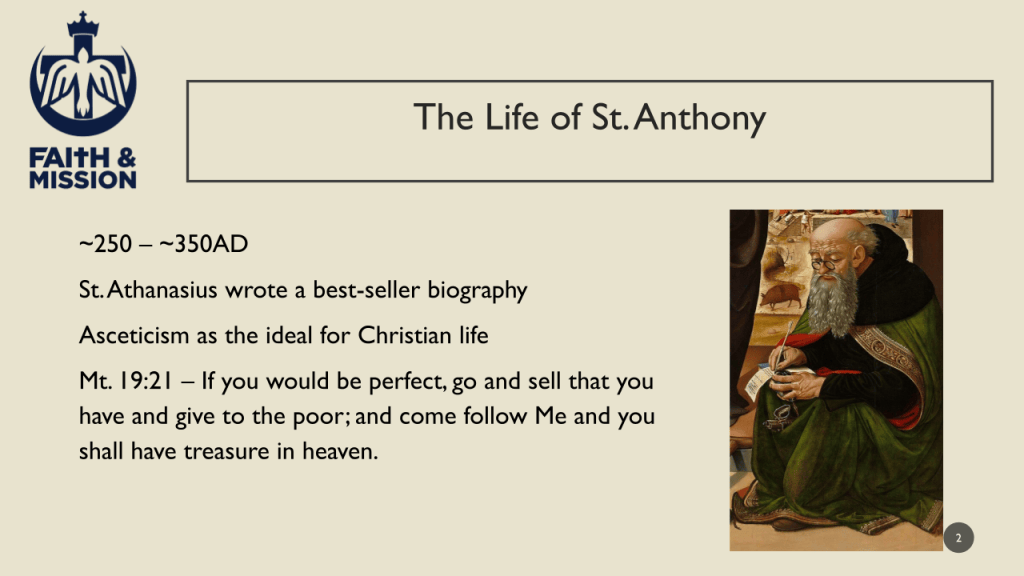
St. Athanasius wrote a biography of St. Anthony, and this is our primary source. Most of what is known about Anthony comes from the Life of Anthony. Written in Greek c. 360, the concept of monks is already somewhat established in Christian North Africa. Athanasius was associated with Alexandria, a great city in Egypt, and the deserts were there for people who sought a life of asceticism and fighting the temptations of the Devil as Jesus had.
Anthony was born in Lower Egypt to wealthy landowner parents. When he was about 20 years old, his parents died and left him with the care of his unmarried sister. Shortly thereafter, he decided to follow the gospel exhortation in Matthew 19: 21, “If you want to be perfect, go, sell what you have and give to the poor, and you will have treasures in heaven.” Anthony gave away some of his family’s lands to his neighbors, sold the remaining property, and donated the funds to the poor. He then left to live an ascetic life, placing his sister with a group of Christian virgins. While others had lived apart from regular life, Anthony seems to have been one of the first to go out into the wilderness of the desert alone.
Most men who set themselves apart, did so in communities. This is called the “cenobitic” life, and it is the term that describes what we think of when we think of monks. But there were from time to time individuals who lived alone. Stylites were individuals who lived alone at the top of a pillar. Anthony was the most famous one to go live alone in the desert.
Athanasius describes Anthony’s training this way:
He subjected himself in sincerity to the good men whom he visited, and learned thoroughly where each surpassed him in zeal and discipline. He observed the graciousness of one; the unceasing prayer of another; he took knowledge of another’s freedom from anger and another’s loving-kindness; he gave heed to one as he watched, to another as he studied; one he admired for his endurance, another for his fasting and sleeping on the ground; the meekness of one and the long-suffering of another he watched with care, while he took note of the piety towards Christ and the mutual love which animated all. Thus filled, he returned to his own place of discipline, and henceforth would strive to unite the qualities of each, and was eager to show in himself the virtues of all.
Athansius explains that this kind of life disturbs the Devil, and so the Devil showed up and tried to thwart Anthony’s life of holiness:
First of all he tried to lead him away from the discipline, whispering to him the remembrance of his wealth, care for his sister, claims of kindred, love of money, love of glory, the various pleasures of the table and the other relaxations of life, and at last the difficulty of virtue and the labour of it; he suggested also the infirmity of the body and the length of the time.
When whispering did not seem to work, Athanasius says the Devil attacked St. Anthony:
he attacked the young man, disturbing him by night and harassing him by day, so that even the onlookers saw the struggle which was going on between them. The one would suggest foul thoughts and the other counter them with prayers: the one fire him with lust, the other, as one who seemed to blush, fortify his body with faith, prayers, and fasting.
St. Athanasius gives us a sense of Anthony’s asceticism:
He kept vigil to such an extent that he often continued the whole night without sleep; and this not once but often, to the marvel of others. He ate once a day, after sunset, sometimes once in two days, and often even in four. His food was bread and salt, his drink, water only. Of flesh and wine it is superfluous even to speak, since no such thing was found with the other earnest men. A rush mat served him to sleep upon, but for the most part he lay upon the bare ground.
Anthony lived alone for 20 years. He came out of his mountain hole finally because many men were seeking to learn from him and were ready to break down the door to see him.
And so for nearly twenty years he continued training himself in solitude, never going forth, and but seldom seen by any. After this, when many were eager and wishful to imitate his discipline, and his acquaintances came and began to cast down and wrench off the door by force, Antony, as from a shrine, came forth initiated in the mysteries and filled with the Spirit of God. Then for the first time he was seen outside the fort by those who came to see him. And they, when they saw him, wondered at the sight, for he had the same habit of body as before, and was neither fat, like a man without exercise, nor lean from fasting and striving with the demons, but he was just the same as they had known him before his retirement.
St. Anthony explained to his followers the heart of the ascetic life:
Wherefore, children, let us not faint nor deem that the time is long, or that we are doing something great, “for the sufferings of this present time are not worthy to be compared with the glory which shall be revealed to us-ward Romans 8:18 .” Nor let us think, as we look at the world, that we have renounced anything of much consequence, for the whole earth is very small compared with all the heaven.
The power of Anthony’s teaching was such that men followed his example and soon there was a community. St. Athanasius describes it thusly:
So their cells were in the mountains, like filled with holy bands of men who sang psalms, loved reading, fasted, prayed, rejoiced in the hope of things to come, laboured in almsgiving, and preserved love and harmony one with another. And truly it was possible, as it were, to behold a land set by itself, filled with piety and justice.
Anthony sought a more remote place, and God used Arabs to lead him to an inner mountain where he lived alone. But eventually the followers found him. They all worked out a compromise: Anthony lived alone but the brethren were close enough to bring him bread and olives every month since he was now old. He died at 105 years old.
St. Anthony was famous throughout the Mediterranean world. People came also from foreign parts to him, and like all others, having got some benefit, returned, as though set forward by a father. A certain Duke Balacius was warned by Antony but went ahead with his evil plan, and he met with a miserable end: his partner’s horse with a bite dismounted Balacius, and attacked him, and tore his thigh so badly with its teeth that he was borne straight back to the city, and in three days died.
He foresaw the destruction of Arius and warned the people around him. The Emperor Constantine Augustus, and his sons Constantius and Constans wrote letters to him, as to a father, and begged an answer from him. He eventually replied with a letter urging them to ‘not to think much of the present, but rather to remember the judgment that is coming, and to know that Christ alone was the true and Eternal King.’
Greek philosophers came to test him, and it did not work out as they expected:
And Antony also was exceedingly prudent, and the wonder was that although he had not learned letters, he was a ready-witted and sagacious man. At all events two Greek philosophers once came, thinking they could try their skill on Antony; and he was in the outer mountain, and having recognised who they were from their appearance, he came to them and said to them by means of an interpreter, ‘Why, philosophers, did ye trouble yourselves so much to come to a foolish man?’ And when they said that he was not a foolish man, but exceedingly prudent, he said to them, ‘If you came to a foolish man, your labour is superfluous; but if you think me prudent become as I am, for we ought to imitate what is good. And if I had come to you I should have imitated you; but if you to me, become as I am, for I am a Christian.’
While Paul the Hermit was probably doing the ascetic life before Anthony, Anthony’s biography made him the more famous example of monastic asceticism. Athanasius writes, “For monks, the life of Anthony is a sufficient example of asceticism. His story influenced the conversion of Augustine of Hippo and John Chrysostom.
It is likely Augustine modeled his community on the life of St. Anthony.


Leave a comment