Slide – Catholic Social Teaching
We use the term Catholic social teaching to describe a body of thought and action that is fairly recent in the church’s history and in many ways dominates the attention and budget of the modern Catholic Church, especially the Catholic Church in America. The term mixes something that is in the world but not of the world — the Catholic faith — with something that is in the world and not of the next world — the current material state of society — which is why it can be a source of confusion for Catholics today.
On the one hand, we hear from papal and Episcopal pulpits constant commentary on social issues like poverty and mass migration, and on the other hand, much of that commentary is indistinguishable from what we hear from secular social and political activists. This can create some discomfort on the part of an ordinary Catholic person as he tries to find the right way to understand what he is hearing from his church hierarchy.
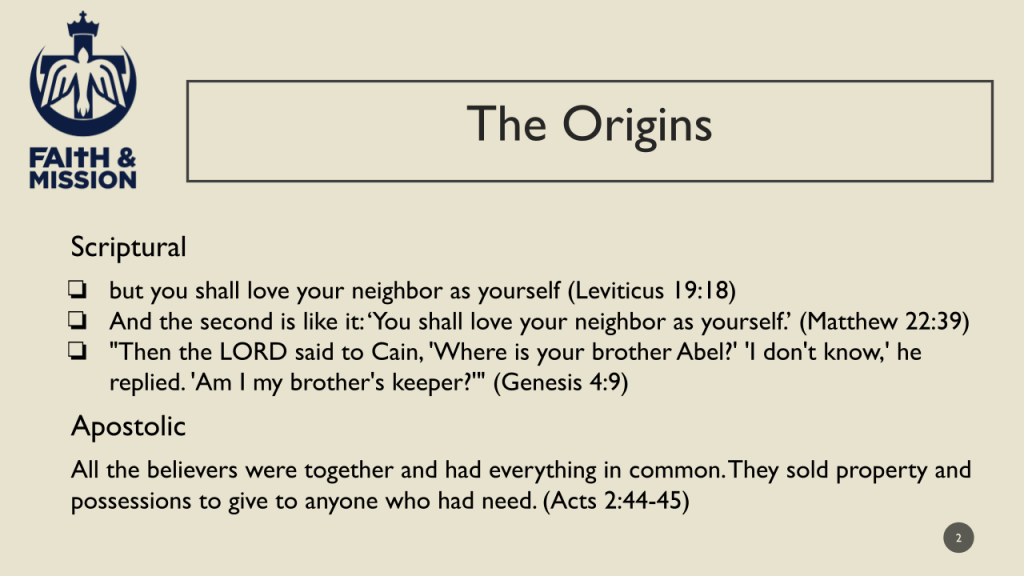
So where do our overseers get the idea that social issues like poverty and mass migration are matters that should concern God’s disciples? We get this idea from our own holy Scriptures. Starting in the book of Genesis, continuing through the book of the laws of Leviticus, and culminating in the direct words of Jesus Christ in the Gospel of Matthew as well as in other Gospels, we get the clear instruction that we really are responsible in some way for the other people with whom we share the planet. And we are particularly responsible for our neighbors: the people who share our little part of the planet.
Remember that when there were only four people in the world, one of them killed one of the others. And when God asked Cain about his brother Abel, Cain tried to dodge the question by asking another question: “am I my brother’s keeper?” The answer to that question the church understands to be an unequivocal “yes.” When the Israelites are receiving the law from God through Moses in the book of Leviticus, they are told that they shall love their neighbor as themselves.
We recently had as the Sunday gospel the scene in which a scholar of the law tries to test Jesus by asking which is the greatest commandment. Jesus is a well educated Jew, so he gives the correct answer. He quotes what is known as the Shema. That is the instruction to hear O Israel that you shall love the Lord your God with all your heart, with all your mind, with all your strength. Jesus immediately adds the second great commandment, that you shall love your neighbor as yourself.
So it is very clear from the Old Testament and the gospels that loving God and loving our neighbor are deeply connected. And certainly the words of Scripture are very clear that our love of God and neighbor will be properly manifested by activity on our part. We can’t just sit and love God without doing anything; and we can’t just love our neighbor without getting up off the couch and actually doing something about it.
And from the book of the Acts, we get very clearly and very early in the story the sense that the neighbors took care of each other. Here in the second chapter of the acts of the apostles we are told, “all the believers were together and had everything in common. They sold property and possessions to give to anyone who had need.”
Thus we can say with great confidence that the origin of Catholic social teaching is ultimately the second great commandment which was given to the Israelites and confirmed by Jesus Christ himself. So if we do not make any effort to take care of our neighbor, then we are not authentically being disciples of Christ. This social responsibility is intrinsic to Christian life.
The impact of the industrial revolution
Catholic social teaching grew out of the Industrial Revolution, so we need to take a few minutes and understand what we mean by that term. We just celebrated the 250th anniversary of the founding of United States of America, so let’s go back to 1776 or thereabouts. At that time, wealth was primarily tied to land and the things that came out of land. Food came out of land in the form of wheat and corn and also animals like cattle and chickens. Land was cultivated by hand with the assistance of some draft animals like ox and mules. In transportation moved at the speed that a draft animal walked, so roughly 3 to 4 mi. an hour. There were specialized manufacturers who made things in their own shops, and they started with the raw material and sold the finished product. Think of Paul Revere, who was a silversmith by day and a revolutionary by night. Men like Paul Revere learned a trade such as silver smithing through apprenticeship. They lived with a master of the trade and learned how to do the tricks of the trade over a long period. At the end of their apprenticeship, they became an independent craftsman in their particular trade. The production of whatever it is that they produced happened at a human speed.
Everything I just described was the state of economic production in 1780. All of that had changed by 1880. Over that 100 years, in Europe and in America, we saw the rise of large cities. Those large cities were the location of factories, which replaced the independent craftsman as the place where production happened. Paul Revere, the independent silversmith, was replaced by a factory which cranked out silverware for mass consumption at much lower prices than the individually made silver pieces that Paul Revere had been selling.
This rapid change was made possible by the introduction of non–human and non-animal sources of power. The first source of power was moving water, and mills began to be constructed next to rivers and streams whose waterpower could be harnessed for the production of flour and other such commodity goods. That was soon replaced by steam power, as the steam engine was invented in the 18th century and improved over the next hundred years. Steam was typically powered by coal, which had to be mined by men and was a difficult and dirty job. Steam engines could come in a variety of sizes, and one place they were put was in the transportation system. Railroads were only possible because of steam engines. Ships could suddenly motor from place to place without depending on the wind because of steam engines. This meant that transportation of produce and production goods no longer had to rely on the strength of humans or animals. Because railroads were dependable, we suddenly needed to know what time it was. And this is where time zones came to exist and we no longer talked about noon but we started to talk about 12 o’clock.
Railroads and steam engines and factories all required a great deal more financial capital than did Paul Revere in his craft shop making his silver goods. In the financial industry responded. So we had the rise of financial markets and financial instruments and financial sophistication, and of course we had financial shenanigans and fraud.
The rise of technological and financial innovation occurred at the same time that we saw the rise of nation states that were independent of an established religion. The United States was founded on the idea that there should not be one church that was supported by the government and its taxing authority. This was in contrast to England, which had a Church of England in which the clergymen were essentially employees of the state and King. In France, the French Revolution was expressly atheist. Napoleon followed the French Revolution but he supported the idea that France should as much as possible control the Catholic Church in France and not allow the Pope much of a voice in French life.
So, 100 years after the founding of the United States, the world had changed dramatically. Entire countries had become significantly less rural as people migrated to cities where they could find jobs that paid well. Entire countries had become significantly less Catholic, as the most developed nations were the least Catholic nations. The quality of life for an individual worker was much less human or humane, as the jobs that replaced the old farm jobs were difficult jobs down in the mine or in a factory.
And I found a couple of pictures to give you a sense of how profound this change was. First, a craftsman at his bench with his tools. Second, a large factory pumping out products and pumping out smog from its smokestacks.
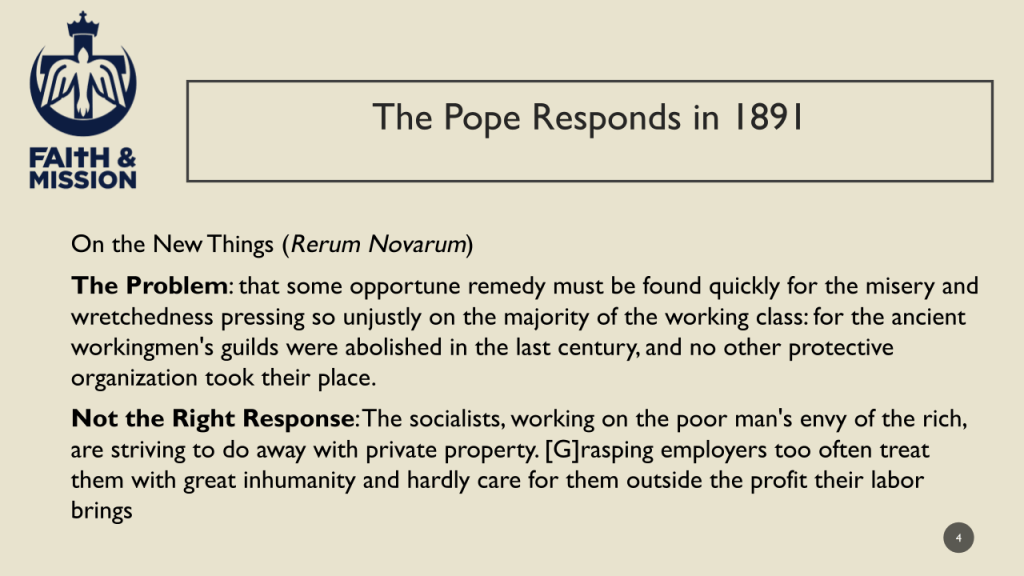
Pope Leo the 13th was the Pope at the time this fundamental change in the life of the everyday person became undeniable. And he wrote an encyclical — a letter to the whole world — on this new phenomenon. Indeed, the name of the document is “on the new things,” or in Latin, “Rerum Novarum.” You may remember that papal documents like this are typically named by the first couple of words in Latin, though these days they frequently add an English title as well because fewer people today know enough Latin.
The holy father acknowledges that there is a problem. And he acknowledges that we must find some helpful response to this problem because we now have a thing called the working class, and life for the working class is pretty awful. And then he explains the mistakes made by different approaches to address the problem.
So let’s take a moment and talk about what those responses were. And here I think it is helpful to remind ourselves of the book that we went through written by Msgr. Jane Shea. That book was called “the religion of the day,” and it explained that despite their claims of not being religious, there is in fact a non-Christian religion which he ended up calling Neo-Gnostic progressivism.
If you recall, he explained that this religion identifies a real problem in society and then offers a non-Christian response with the promise that their program will solve the problem. He points out that their program never does solve the problem, which is why they move on to a new problem and offer a new solution to the new problem.
Well, in the middle part of the 19th century, this non-Christian religion got its holy Scripture when Marx and Engels wrote “the Communist manifesto.” In that book, the authors correctly identified the tragedy of human workers and their terrible working environment and conditions. The authors proposed a revolution in which the current owners of the factories would be removed and the workers would own the means of production and somehow working conditions would improve dramatically and the distribution of produced goods would be perfectly just and fair. We all have had over 150 years of experience with this socialist program, so we know that it never works, but this was the first time it was proposed and there was some thought that it might work.
Pope Leo the 13th understood that the job of the holy father is not the repair of imperfect means of production and distribution of what is produced. He understood that the job of the holy father is to preserve and protect the authentic teaching of the apostles that was received directly from Jesus Christ, who is Lord and Master of all whether they admit it or not.
So the Pope’s response to the new things was to explain that the Socialists cannot be right. He explained that they cannot be right because their program denies the reality of the human person. The Pope explained that the human person is made in the image and likeness of the creator God, and this likeness endows the human person with dignity that cannot be violated. Part of that dignity is the right to private property. But the socialists deny that there is such a thing as private property. Their program insists that everything is owned by the state. The Pope pointed out that the Socialists program uses the vice of envy as the means to reach a good outcome of a more just distribution of the goods of the world. Catholic moral theology insists that one can never use bad means to get a good end. We hear that in the everyday phrase that the means do not justify the ends. So the socialists are wrong on two important points. First, they are wrong in that they don’t respect the human person. Second, they are wrong and that they are willing to use evil ways to get what they believe is a good end.
The fact that the socialists are wrong does not automatically make the owners of capital right. The holy father explains that employers have likewise lost sight of the intrinsic dignity of every human person because every human person was made in the image and likeness of God.
The socialists are wrong, says the holy father, because the human person is not merely a cog in the machine of the state. The capitalists are wrong, he says, because the human person is also not merely a cog in the machine of economic production. Both responses have lost sight of the human person.
Pope Leo wrote extensively on this subject in other letters and exhortations, and the Popes that followed him would come back from time to time to review and update the teaching on humanity and the economy. We will look at some of that next time.
Let’s turn now to the United States and what was happening here. At the end of the 19th Century, Europe was shedding its Christian heritage at a staggering rate, but the United States remained a Christian nation. It was overwhelmingly a Protestant Christian nation, for only in New Orleans and perhaps Mobile were Catholics at the top of the social ladder. Everywhere else in the United States, Catholicism was the religion of the lower economic classes: the Irish, the Italians, and the like. So we must look at what was going on in Protestant circles and then look at how American Catholics got involved.
The first movement grew out of the Protestant activism of abolitionism, the Protestants in the Northern States led the moral campaign against slavery before the War Between the States. That same moral energy and activism was seen in the Temperance movement, a program of social improvement by eliminating alcohol consumption. These themes of Protestant social superiority and purity were captured in a speech given during the 1884 Presidential election that labeled the other side as the party of “Rum, Romanism, and Rebellion.” The Republican candidate was James G. Blaine, and the speech backfired and resulted in the election of Grover Cleveland. That such a phrase would be thought to be effective in politics shows us how dominant was the Protestant side of society at the time of the Industrial Revolution in America.
Social Gospel
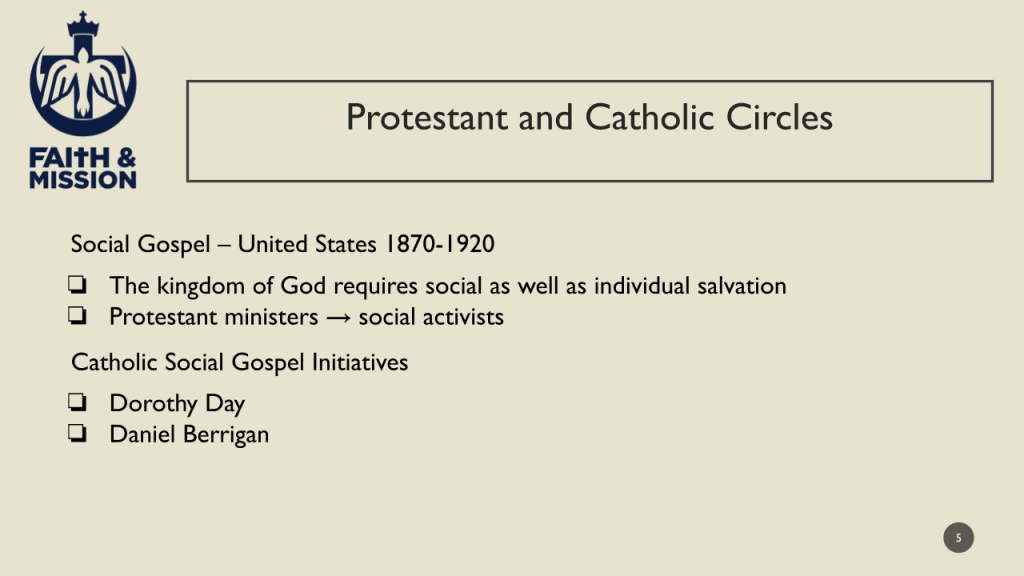
Social Gospel, religious social reform movement prominent in the United States from about 1870 to 1920. Advocates of the movement interpreted the kingdom of God as requiring social as well as individual salvation and sought the betterment of industrialized society through application of the biblical principles of charity and justice.
The Social Gospel was especially promulgated among liberal Protestant ministers, including Washington Gladden and Lyman Abbott, and was shaped by the persuasive works of Charles Monroe Sheldon (In His Steps: What Would Jesus Do? [1896]) and Walter Rauschenbusch (Christianity and the Social Crisis [1907]). Labor reforms—including the abolition of child labor, a shorter workweek, a living wage, and factory regulation—constituted the Social Gospel’s most prominent concerns.
Washington Gladden
American Congregational minister, crusading journalist, and author. He served as pastor of two congregations in Massachusetts. Gladden opposed both socialism and classical economic theory and sought to apply “Christian law” to social problems; some consider him the first American clergyman of note to approve of unionization.
Lyman Abbott
American Congregational minister, crusading journalist. Trained as a lawyer, he left law practice to study theology and was ordained in 1860. He succeeded Henry Ward Beecher (a famous abolitionist) as pastor of an important Brooklyn church in 1888. Abbott became interested in the social problems associated with the Industrial Revolution of the late 19th century. Under his editorship the Christian Union (renamed Outlook in 1893) promulgated the Social Gospel, which sought to apply Christianity to social and industrial problems. His Christianity and Social Problems (1897), The Rights of Man (1901), He rejected both socialism and laissez-faire capitalism. On other problems, Abbott presented the viewpoint of liberal Evangelical Protestantism. He sought to interpret, rather than condemn, the effect of the theory of evolution on religion.
Walter Rauschenbusch
He was a Baptist who had worked with the poor in the area called Hell’s Kitchen in New York City. He used the biblical idea of the kingdom of God to articulate a progressive Christian vision of how to transform capitalist America into a cooperative Christian society. This social gospel pervaded the central institutions of the Protestant mainstream in the decades before the First World War. In Christianity and the Social Crisis, Rauschenbusch traced the social gospel back to the lives of the Hebrew prophets. He stated that rather than ritualistic ceremonies, the prophets “insisted on a right life as the true worship of God”. This “right life” included the belief that “social problems are moral problems on a large scale”.
Norman Thomas
Union Theological Seminary in New York City, graduating in 1911. At the time, Union was a major epicenter of Social Gospel theology and liberal politics. It was here that he heavily read and was influenced by the father of the Social Gospel, Walter Rauschenbusch. The early social gospel movement emerged during the rapidly industrializing American society following the Civil War. Recognizing the injustices of “triumphant capitalism,” some progressive ministers prescribed a large dose of “practical Christianity” to right these wrongs and directly address the social needs of the era. One of the most prominent was Walter Rauschenbusch, a German-American who pastored a church in the Hell’s Kitchen district of New York in the late nineteenth century. In the United States prior to the First World War, the Social Gospel was the religious wing of the progressive movement which had the aim of combating injustice, suffering and poverty in society. Denver, Colorado, was a center of Social Gospel activism.
Catholic Social Gospel Initiatives
In the United States, Dorothy Day’s Catholic Worker was the first well-known group. It was a lay movement in the United States and Canada, emphasizing personal reform, radical agrarianism, absolute pacifism, and the personal practice of the principles in Jesus’ Sermon on the Mount. The movement was founded in 1933 by Dorothy Day.
The movement gained traction from Day and Maurin’s monthly newspaper, the Catholic Worker, through which they advanced the Catholic notion of the “preferential option for the poor” and various other Catholic social teachings. A group that gathered in New York City under Day’s leadership put the program into action with the creation of houses of hospitality where movement members lived in the community with the homeless and needy. Their example was followed elsewhere in the United States and Canada by local groups, each of which operated independently. Before World War II there were 35 of these groups, maintaining houses of hospitality and farming communes, scattered from Vermont to California.
Daniel Berrigan SSJ, was born in 1923 and became a peace activist in the 1960s after serving Black American communities as a Josephite priest. He regularly engaged in and encouraged illegal activities performed in the name of pacifism and racial justice. He got arrested multiple times during the Vietnam War for destroying draft card records. He – while still a priest – married a nun.


Leave a Reply