Benedict had begun his monastic life as a hermit, but he had come to see the difficulties and spiritual dangers of a solitary life, even though he continued to regard it as the crown of the monastic life for a mature and experienced spirit. His Rule is concerned with a life spent wholly in community, and among his contributions to the practices of the monastic life none is more important than his establishment of a full year’s probation, followed by a solemn vow of obedience to the Rule as mediated by the abbot of the monastery to which the monk vowed a lifelong residence.
The 73 brief chapters of the RB make up four major sections. The Prologue through RB 7 are a foundational primer; RB 8-20 speak of liturgical prayer; RB 20-67 include teachings for the common life; and RB 68-72 offer a theology of monastic life with an emphasis on love. RB 73, the final chapter, is more or less a bibliography for all that precedes it.
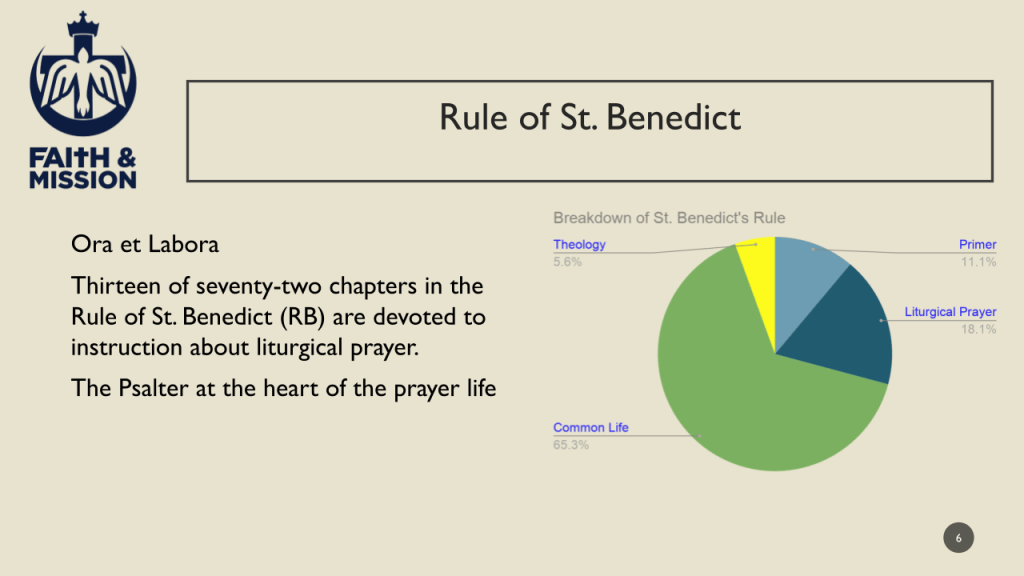
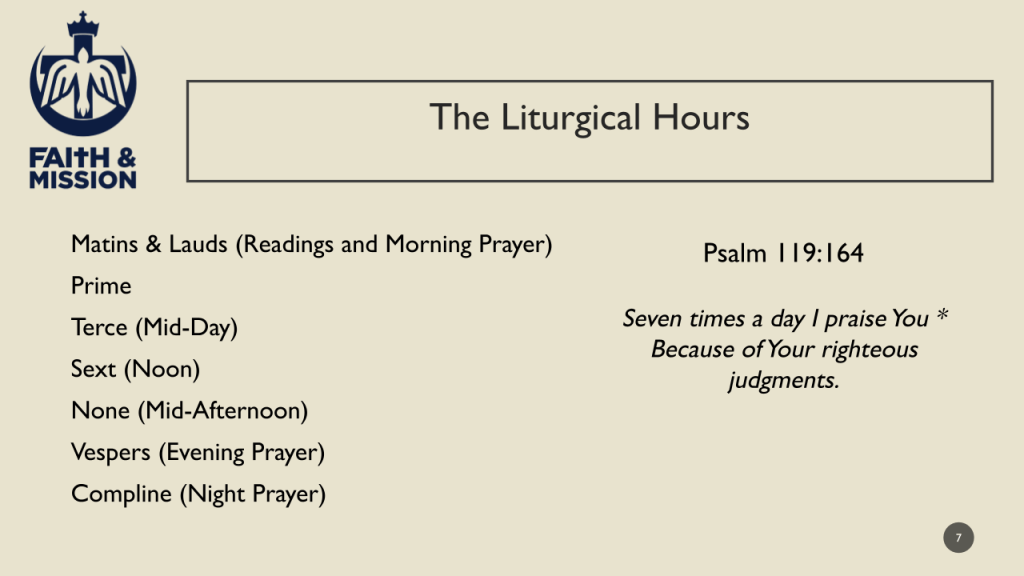
Thirteen of seventy-two chapters in the Rule of St. Benedict (RB) are devoted to instruction about liturgical prayer. Benedict goes to great lengths to establish a rhythm of life in community which is punctuated by prayer (the liturgy of the hours) and saturated in Scripture. Most central is praying the Psalms, which reflects the longstanding appreciation for the way this form of Scripture connects so deeply with the human experience.
The Rule of St. Benedict is saturated with Scripture. Scripture and baptism undergird the Benedictine vision of Christian discipleship, a vision which relies on a prayerful orientation toward God and relationships which support us in Christ-centeredness. Thus prayer and community are at the heart of the Benedictine school of spirituality.
The power of the Psalter
Almost every Psalm speaks to at least one of three movements: orientation, disorientation and reorientation.
Orientation speaks to a sense of equilibrium and confidence in God, as we see in Ps 139: “I praise you for I am fearfully and wonderfully made.”
Disorientation describes the experience of living with chaos, disorder and a lack of wholeness. Ps 13, for example, begins, “How long, O Lord? Will you forget me forever?”
Reorientation is the gift of surprise, graciousness, caring, friendship and hope, much like Ps 103: “as far as the east is from the west, so far he removes our transgressions from us.”
Benedictines – and all Christians – pray the Psalms for our own personal formation and in intercession for the world, which is an important nuance to remember on those days when a particular Psalm does not resonate with our immediate experience. Someone somewhere is in a state of disorientation and we pray on their behalf, just as somewhere in the world others are now praying Psalms of reorientation for us. The discipline of praying the Psalms is one form of submitting to God’s work through this mutuality.
The importance of humility
It is interesting to note that the chapter on humility, the longest chapter in RB, precedes immediately the instruction on liturgical prayer. And what follows that section in chapter nineteen and twenty are about praying with reverence: “Let us stand to sing the psalms in such a way that our minds are in harmony with our voices” (19:7) and “lay our petitions before the Lord God of all things with the utmost humility and sincere devotion” (20:2). The importance of praying the Psalms with humility and authenticity are clear. What makes praying the Psalms an essential Benedictine practice is that it epitomizes the intersection of prayer and community.


Leave a Reply