Benedictine spirituality offers an important voice in our world today, a voice which informs our praying, living and discerning. It is one among many schools that speak to contemporary hearts, yet it is particularly unique in its lasting impact on Western Christianity.
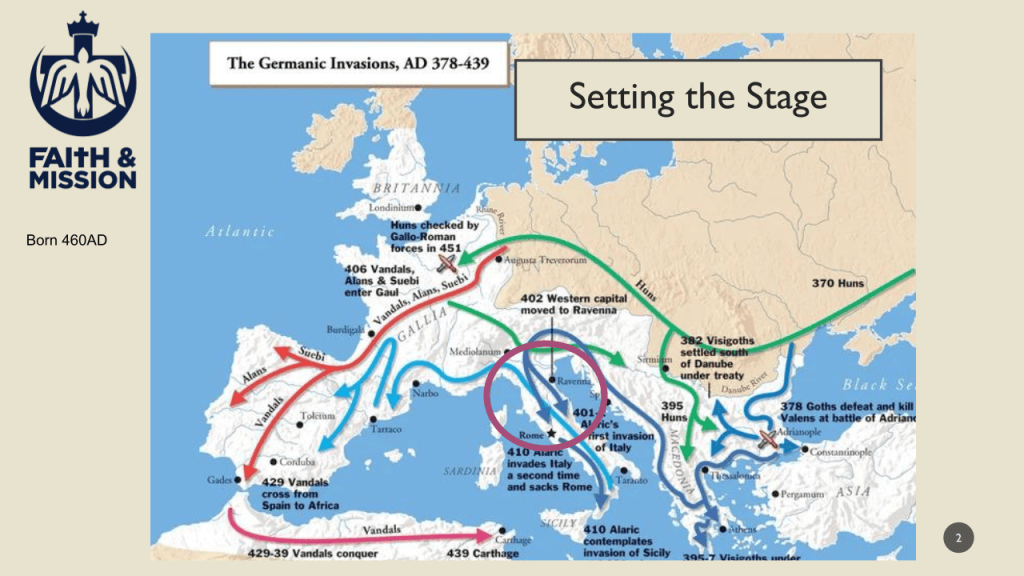
The Fall of the Western Roman Empire
The Western Roman Empire had officially fallen in 476 AD when Odoacer deposed the last Roman emperor, Romulus Augustulus. But the Visigoths under Alaric had already sacked Rome in 410. And prior to the Visigoths, the Roman Emperor Justinian (the Apostate) blamed Christianity for the decay of the Empire and tried to crush the Church during his rule in the middle of the Fourth Century. So, the Roman Empire had been falling apart slowly for 100s of years before it suddenly fell in 476.
Italy was ruled by the Ostrogoths, an Arian Germanic king named Theodoric the Great, who maintained a fragile peace and a mix of Roman and Gothic administration until his death in 526 AD. shortly after Benedict founded his famous monastery at Monte Cassino in 529 AD, the Byzantine (Eastern Roman) Emperor Justinian I launched the devastating Gothic Wars (535–554 AD) to reconquer Italy, leaving the Italian countryside ruined, depopulated, and impoverished. Benedict was born around 480 AD and sent to Rome as a young man to study. He became deeply disillusioned and shocked by the moral decay, social chaos, and rampant vice of life in the aging imperial capital. amid widespread political instability and the breakdown of classical infrastructure, Benedict’s communities became self-sustaining havens
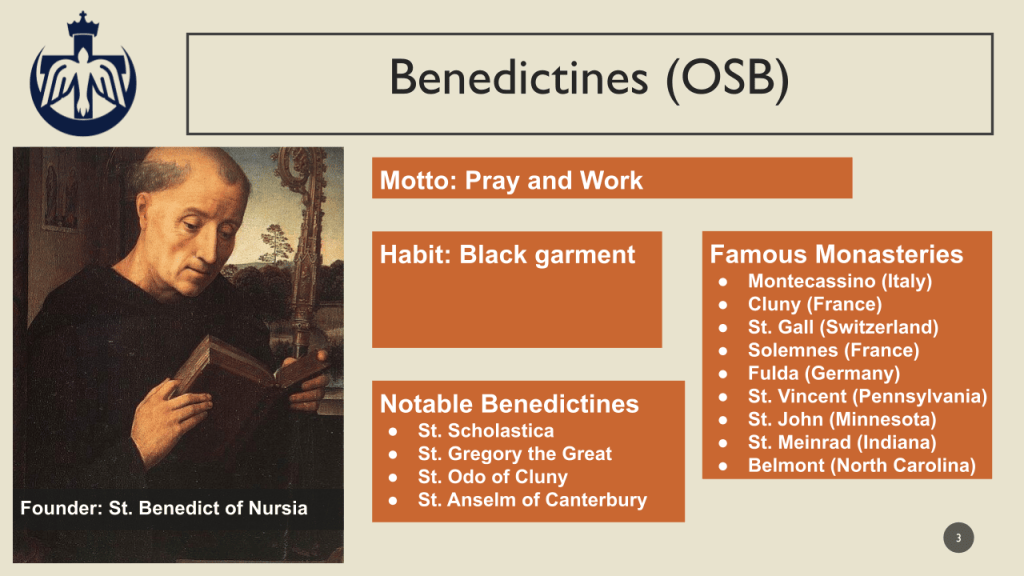
Benedict of Nursia lived from ca. 480 to 547 CE in Italy. The Rule of St. Benedict became a foundational text for monasticism in the West, having emerged in the sixth century as the Roman civilization was collapsing. There was societal chaos and political dissatisfaction. What we know about St. Benedict himself comes to us mainly through Gregory the Great (ca. 540-604 CE), who praised Benedict for his discretion and moderation.
The future, “Father of Monks,” was born in 480 A.D. at Norcia, about 70 miles from Rome. At a young age he left his studies at Rome in pursuit of a life of sanctity and spiritual perfection. He soon settled in the remote area of Subiaco and lived in a cave for three years under the direction of a hermit named Romanus. After the death of Romanus, Benedict accepted the invitation of some nearby monks to be their abbot. The monks, however, were quite wayward and would not take the counsels of Benedict and conspired to poison him. Saint Benedict suspecting their evil intent blessed the goblet of poisoned wine offered him, whereupon it shattered. He then went back into his solitude for a short period of time.
In Benedict’s youth, Rome under King Theodoric still retained vestiges of the old administrative and governmental system, with a Senate and consuls. In 546 Rome was sacked and emptied of inhabitants by the Gothic king Totila, and, when the attempt of Emperor Justinian I to reconquer and hold Italy failed, the papacy filled the administrative vacuum and shortly thereafter became the sovereign power of a small Italian dominion virtually independent of the Eastern Empire.
Other Famous Benedictine Monasteries and Abbeys
Besides Monte Cassino, other famous abbeys and monasteries are Cluny in France, where important reforms were established in the 10th century.
Originating from Cluny Abbey in 910 AD, the Cluniacs became an empire of monasteries across medieval Europe. Unlike modern Benedictines, Cluny was highly centralized under one supreme Abbot and became famous for magnificent architecture, choral music, and incredibly long, beautiful liturgies.
Also, St. Gall in Switzerland, which has a library of ancient manuscripts. It is also where the cardinals met to get Pope Francis elected in 2013. Solesmes in France is famous for its preservation of Gregorian chant in sacred liturgy. Fulda was built in the 8th century and is where St. Boniface is buried.
In the US, St. Vincent Abbey in Latrobe, PA, is a big center of Benedictine thought, and it is where Fr. Boniface Hicks lives (he is a leader in spiritual theology and spiritual direction). St. John Abbey in Minneapolis, MN, has been a center of progressivism in the Catholic Church in the US, especially in liturgical issues. St. Meinrad in Indiana has been a center of training for priests and deacons. Belmont Abbey is just up the road on I-85 west of Charlotte, NC, and is associated with a college there. It was founded in 1876.
Famous Benedictines
Foundational Figures
- Saint Benedict of Nursia (c. 480–547 AD): The founder of Western monasticism and writer of the Rule of St. Benedict, which structured community life around prayer, work, and study (Ora et Labora).
- Saint Scholastica (c. 480–543 AD): St. Benedict’s twin sister, who founded the women’s branch of Benedictine monasticism.
Doctors of the Church & Scholars
- Saint Gregory the Great (540–604 AD): The first monk to become Pope. He popularized the Benedictine Rule across Europe, protected Rome, and famously sent monks to convert Anglo-Saxon England.
- The Venerable Bede (672–735 AD): An English monk and scholar widely known as the “Father of English History” for writing the Ecclesiastical History of the English People.
- Saint Anselm of Canterbury (1033–1109 AD): A brilliant Benedictine philosopher and theologian who originated the Ontological Argument for the existence of God.
- Saint Hildegard von Bingen (1098–1179 AD): A German Benedictine abbess, polymath, and mystic. She was a pioneering musical composer, writer, and medical writer, widely regarded as one of the most brilliant minds of the Middle Ages.
Others
- Guido of Arezzo was an Italian music theorist and pedagogue of High medieval music. A monk from the Order of Saint Benedict, he is regarded as the inventor of the modern staff notation that had a massive influence on the development of Western musical notation and practice.
- Dom Pierre Pérignon, was a French Benedictine monk who made important contributions to the production and quality of champagne wine in an era when the region’s wines were predominantly still red.
Famous Major Historical Offshoots (Independent Orders)
Over the centuries, certain groups sought to return to a stricter, more primitive interpretation of the Rule of St. Benedict. They broke away completely to form their own independent, famous religious orders:
- The Cistercians (“The White Monks”): Founded in 1098 by a group of French monks seeking severe simplicity, manual labor, and literal adherence to the Rule. They shifted away from the elaborate liturgies of the time to focus heavily on agriculture.
- The Trappists (Cistercians of the Strict Observance): A famous 17th-century reform of the Cistercians. They are globally renowned today for their strict vows of silence, contemplative lifestyle, and the high-quality goods they produce to support themselves, such as Trappist beers, cheeses, and jams.
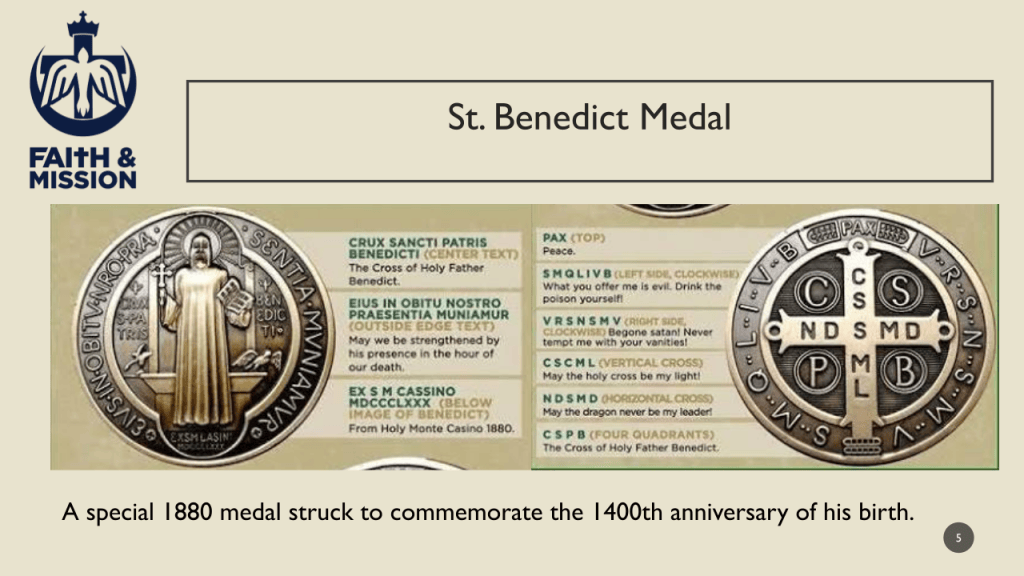
Front
On the face of the medal is the image of Saint Benedict. In his right hand he holds the cross, the Christian’s symbol of salvation. The cross reminds us of the zealous work of evangelizing and civilizing England and Europe carried out mainly by the Benedictine monks and nuns, especially for the sixth to the ninth/tenth centuries.
Rule and Raven
In St. Benedict’s left hand is his Rule for Monasteries that could well be summed up in the words of the Prologue exhorting us to “walk in God’s ways, with the Gospel as our guide.”
On a pedestal to the right of St. Benedict is the poisoned cup, shattered when he made the sign of the cross over it. On a pedestal to the left is a raven about to carry away a loaf of poisoned bread that a jealous enemy had sent to St. Benedict.
C. S. P. B.
Above the cup and the raven are the Latin words: Crux s. patris Benedicti (The Cross of our holy father Benedict). On the margin of the medal, encircling the figure of Benedict, are the Latin words: Eius in obitu nostro praesentia muniamur! (May we be strengthened by his presence in the hour of our death!). Benedictines have always regarded St. Benedict as a special patron of a happy death. He himself died in the chapel at Montecassino while standing with his arms raised up to heaven, supported by the brothers of the monastery, shortly after St. Benedict had received Holy Communion.
Monte Cassino
Below Benedict we read: ex SM Casino MDCCCLXXX (from holy Monte Cassino, 1880). This is the medal struck to commemorate the 1400th anniversary of the birth of Saint Benedict.
On the Back of the medal, the cross is dominant. On the arms of the cross are the initial letters of a rhythmic Latin prayer: Crux sacra sit mihi lux!
Nunquam draco sit mihi dux! (May the holy cross be my light! May the dragon never be my guide!).
In the angles of the cross, the letters C S P B stand for Crux Sancti Patris Benedicti (The cross of our holy father Benedict).
Peace
Above the cross is the word pax (peace), that has been a Benedictine motto for centuries. Around the margin of the back of the medal, the letters V R S N S M V – S M Q L I V B are the initial letters, as mentioned above, of a Latin prayer of exorcism against Satan: Vade retro Satana! Nunquam suade mihi vana! Sunt mala quae libas. Ipse venena bibas! (Begone Satan! Never tempt me with your vanities! What you offer me is evil. Drink the poison yourself!)


Leave a Reply